In mining and quarry operations, grizzly stations are designed to separate fines from oversize rock before material enters the primary crusher. On paper, the process is simple. In practice, oversize rock often bridges across the grizzly, blocks the opening, and interrupts the entire material flow. When that happens, some sites still rely on manual breaking, secondary blasting, or close-range machine intervention to clear the blockage. That approach is risky, slow, and difficult to control.
A Rockbreaker Boom System offers a safer and more consistent way to solve this problem. As a stationary rock breaker installed at the grizzly station, it allows operators to break oversized rock remotely, keep the feed system moving, and reduce the need for people to work close to unstable material. For mines and quarries focused on productivity and safety, it is no longer just an accessory. It is a core part of the material handling system.
Grizzly stations handle material that is often irregular in size, shape, and hardness. Even when blasting, ripping, or excavation is well controlled upstream, there will still be boulders or slabs large enough to hang up on the grizzly bars. Wet material, clay contamination, and slabby rock geometry make the problem worse.
Once a blockage forms, the consequences spread quickly:
Feed to the crusher becomes unstable or stops completely
Loaders and haul trucks begin waiting
Operators are pressured to clear the jam quickly
Site safety deteriorates when manual intervention starts
This is why a grizzly blockage solution should be planned as part of the plant design, not treated as an occasional maintenance issue.
Manual oversize handling is still seen in some operations because it appears flexible and low-cost at first. But the real operating risk is high. Workers may use handheld breakers, torches, improvised methods, or stand too close while an excavator tries to dislodge the rock. Some sites may also use secondary blasting.
These methods create several serious hazards.
Oversize rock lodged at a grizzly station is rarely stable. The moment it is hit, pried, or partially broken, it can shift unexpectedly. Falling rock, rolling fragments, and sudden release of stored material are major dangers for anyone working nearby.
Manual work places people in the hazard zone. Even when the task is done quickly, the operator or support crew is still exposed to impact, dust, noise, vibration, and pinch points.
Using blasting as a manual oversize handling alternative can introduce flyrock risk, vibration, permitting complications, and work stoppages. It may be acceptable in specific controlled situations, but it is not the ideal day-to-day method for clearing grizzly blockages in an active production flow.
Manual methods depend heavily on crew experience, shift conditions, and how accessible the blockage is. Some rocks break easily. Others take repeated attempts. This unpredictability directly affects plant stability.
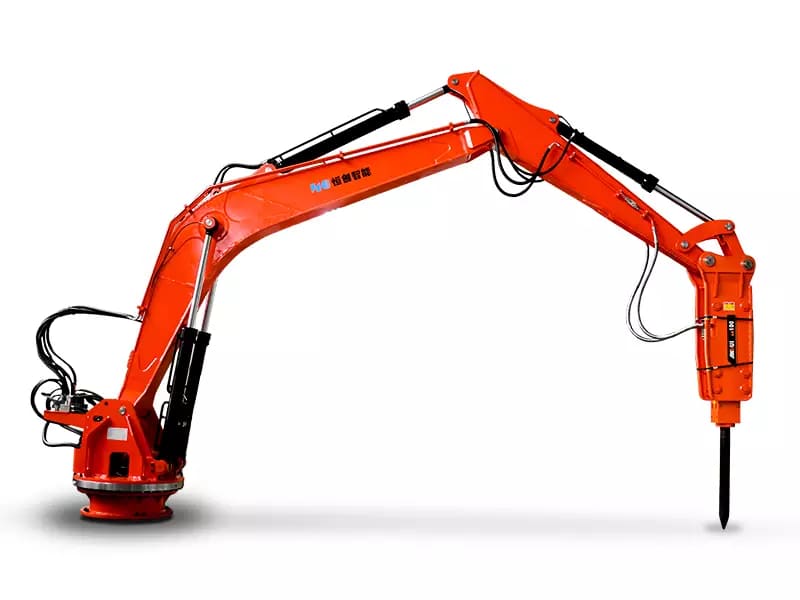
A Rockbreaker Boom System is a purpose-built stationary rock breaker mounted near the grizzly or crusher opening. Equipped with a boom and hydraulic hammer, it allows the operator to position the tool precisely and break oversize rock from a protected location.
This changes the entire operating logic of the station.
A rockbreaker boom system for mining safety reduces the need for personnel to enter the danger zone. The operator works from a safer control position rather than standing beside unstable rock. This is one of the most important pedestal boom safety benefits: hazard separation.
Because the boom is already installed at the station, it can be used immediately when bridging occurs. There is no need to mobilize another machine, wait for access clearance, or improvise a solution. This continuity is critical in high-throughput mines where even short interruptions cascade into lost output.
A stationary rock breaker provides repeatable reach, strike force, and positioning. It is designed specifically for oversize reduction at fixed points such as grizzlies, hoppers, and crusher inlets. That makes it far more efficient than ad hoc manual intervention.
The true value of a stationary boom is not only that it breaks rock. It is that it supports continuous production under controlled conditions.
| Factor | Manual Oversize Handling | Rockbreaker Boom System |
|---|---|---|
| Worker exposure | High | Much lower |
| Response speed | Variable | Immediate |
| Process continuity | Frequent interruptions | More stable |
| Control over breakage | Inconsistent | Precise and repeatable |
| Suitability for regular blockages | Poor | Excellent |
In a busy operation, the difference between occasional clearing and integrated blockage management is significant. A stationary rock breaker helps transform blockage response from a reactive safety risk into a standard operating function.
Throughput losses at a grizzly station are often underestimated. A blockage may only appear to stop one section, but the effect can extend to truck queues, loader idle time, crusher starvation, and lost shift efficiency.
Every minute spent organizing manual clearing reduces productive time. A Rockbreaker Boom System shortens response time and reduces stoppage duration. In plants with repeated oversize events, this can produce meaningful gains in utilization.
When oversize material is managed quickly, the primary crusher receives a steadier feed. This supports better downstream efficiency and reduces the stop-start pattern that harms productivity.
Without a fixed stationary rock breaker, sites may repeatedly bring in excavators, mobile breakers, or additional labor to clear blockages. That adds cost, congestion, and scheduling complexity.
This type of grizzly blockage solution is especially valuable in:
Surface mines handling blasted rock
Underground mining transfer points
Quarries with variable feed size
Primary crushing stations with high truck traffic
Sites prioritizing safety modernization
Wherever oversize rock regularly interrupts flow, a Rockbreaker Boom System is usually more effective than relying on manual methods.
Manual rock breaking, blasting, and close-range oversize handling expose people to unnecessary risk and make production less predictable. A Rockbreaker Boom System gives mines and quarries a safer, faster, and more controlled way to manage blockages at grizzly stations. As a stationary rock breaker, it supports mining safety, improves continuity, and reduces the downtime that oversize rock can cause across the entire operation.
For operations that want a practical manual oversize handling alternative, the answer is clear: a properly selected stationary boom is not just safer than manual clearing, it is better for throughput, equipment coordination, and long-term plant reliability.
Learn more at: https://www.hcrot.com/
The main advantage is that it allows oversize rock to be broken remotely and quickly without sending workers into a hazardous area. It improves both safety and production continuity.
No. It is useful for both mines and quarries wherever oversize rock regularly blocks grizzlies, hoppers, or crusher inlets. The key factor is blockage frequency and the cost of downtime, not just site size.
In many day-to-day blockage situations, yes. A Rockbreaker Boom System often provides a more controlled and safer solution than repeated secondary blasting, especially at fixed material transfer points.