In mining and quarry operations, material flow is everything. When oversized rock blocks the feed opening, production slows, equipment waits, and safety risks increase. This is exactly why a Rockbreaker Boom System is widely used at grizzly stations. It provides a controlled, efficient, and safer way to break oversize material before it causes serious disruption.
A Rockbreaker Boom System is designed to handle rocks that are too large to pass through the grizzly or downstream crushing equipment. Whether the site is a hard rock quarry, an open-pit mine, or an underground operation, this equipment helps maintain steady feed flow and reduces the need for dangerous manual intervention.
A grizzly station is a material handling point where run-of-mine rock or blasted stone is dumped onto a set of heavy-duty bars or grids. These bars allow smaller material to pass through while holding back oversized rock that could damage or block the crusher.
Grizzly stations are commonly installed:
Above primary crushers
At mine ore passes
At quarry feed hoppers
At fixed crushing and screening plants
Their role is simple but critical: separate acceptable feed from oversize material before it enters the next stage of processing.
At this point, a rockbreaker boom system for grizzly becomes essential. When boulders bridge across the bars or sit stubbornly on top of the grizzly, the boom system positions a hydraulic breaker to reduce the rock to a manageable size.
Oversize problems at grizzly stations are common because blasted rock is rarely uniform. Even with good blast design, some material will still come out larger than the target size.
Several factors make blockage likely:
Large rocks are not only big; they are often elongated, flat, or angular. These shapes can wedge across the grizzly bars more easily than evenly shaped material.
Drilling and blasting conditions change from bench to bench. Hard zones, fractured zones, and inconsistent burden can all create oversize rock.
Many grizzly stations feed directly into crushers or bins with limited opening dimensions. A rock that looks passable from one angle may jam when it rotates or settles.
When haul trucks dump quickly and continuously, oversized rock has less time to settle properly. This can create bridging and choke points at the grizzly.
Sticky fines, clay, or mixed-size feed can worsen flow conditions and make it harder for oversized chunks to move or reposition naturally.
This is why a grizzly rock breaker is not just an accessory. It is a practical production tool that keeps material moving and protects plant utilization.
Before remote systems became common, workers often used dangerous manual methods to deal with oversize rock. These methods included using bars, chains, mobile machines, or even secondary blasting in some cases. All of them exposed personnel to significant hazards.
Falling rock from unstable material piles
Sudden movement of bridged ore
Working too close to hopper edges
Dust exposure and poor visibility
Equipment collision in confined dump areas
Delayed response during production pressure
Manual oversize handling at grizzly stations is especially risky because the blocked rock is often under load. Once it shifts, it can move without warning. This is one of the strongest arguments for a stationary rock breaker for grizzly applications: it removes the operator from the immediate danger zone.
With a modern Rockbreaker Boom System, the operator can control the breaker remotely from a protected cabin or control station. This greatly reduces exposure to rock fall, moving material, and machine interaction hazards.
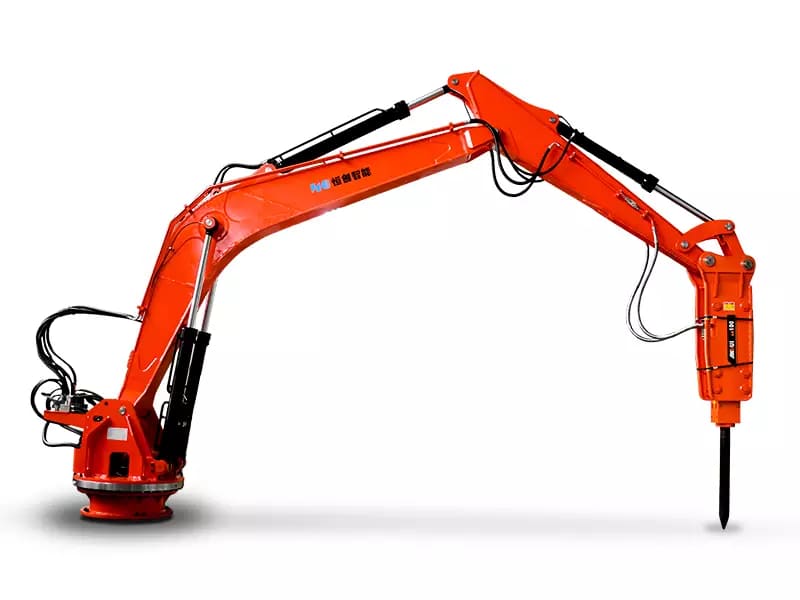
A Rockbreaker Boom System combines three main components: a pedestal-mounted boom, a hydraulic breaker, and a control system. Together, they allow the operator to reach, position, and break oversized rock efficiently.
Oversized rock gets stuck on or above the grizzly.
The operator activates the pedestal boom system for grizzly handling.
The boom extends and positions the hydraulic breaker over the blockage.
The breaker applies repeated impact energy to fracture the rock.
Broken pieces fall through the grizzly or become small enough for further handling.
Fast response to blockages
Precise positioning in tight spaces
Less interruption to haulage and crushing
Improved operator safety
Better control compared with improvised manual methods
Some advanced systems also include:
Radio remote control
Enclosed operator stations
Automatic lubrication
Heat-resistant or cold-weather packages
Custom boom geometry for specific hopper sizes
A Rockbreaker Boom System is suitable anywhere oversize rock regularly blocks a grizzly, hopper, or crusher feed opening.
| Site Type | Typical Use of Rockbreaker Boom System |
|---|---|
| Hard rock quarries | Breaking boulders at primary crusher feed points |
| Metal mines | Managing oversize ore at grizzly stations and ore passes |
| Gold mines | Maintaining consistent feed to crushing circuits |
| Copper and iron ore mines | Handling large run-of-mine material |
| Limestone quarries | Reducing blockages above stationary crushers |
| Underground mines | Breaking oversize at fixed tipping or transfer points |
In these environments, oversize handling at grizzly stations is not occasional. It is part of normal production reality. A stationary system is often more efficient than sending in mobile equipment each time a blockage appears.
A dedicated grizzly rock breaker offers operational advantages over ad hoc methods.
| Method | Safety | Efficiency | Control | Suitability for Repeated Oversize |
|---|---|---|---|---|
| Manual handling | Low | Low | Poor | Poor |
| Mobile excavator with breaker | Medium | Medium | Moderate | Limited |
| Rockbreaker Boom System | High | High | Precise | Excellent |
A fixed Rockbreaker Boom System is always ready. It does not need repositioning from another work area, and it can be matched precisely to the grizzly layout, rock size, and duty cycle.
Not every site needs the same boom size or breaker class. Selection depends on:
Hopper and grizzly dimensions
Maximum rock size
Required horizontal reach and vertical coverage
Material hardness
Duty frequency
Installation space
Climate and environmental conditions
For example, a quarry with moderate limestone feed may need a lighter pedestal boom system for grizzly duty, while a large metal mine handling hard, abrasive ore may require a heavier boom and more powerful breaker.
A Rockbreaker Boom System is one of the most effective solutions for oversize problems at grizzly stations. It helps break blocked rock quickly, improves feed continuity, reduces downtime, and most importantly, keeps workers away from hazardous manual clearing tasks. For mines and quarries dealing with frequent blockages, a properly selected rockbreaker boom system for grizzly applications is not just a productivity upgrade. It is a key part of safer and more reliable plant operation.
To learn more about rockbreaking solutions for mining and quarry applications, visit: https://www.hcrot.com/
A Rockbreaker Boom System is fixed in place, usually above a grizzly or crusher hopper, and is always available for immediate use. A mobile breaker must be brought to the blockage area, which takes more time and may be less efficient for repeated oversize events.
No. It is used in both mines and quarries of different sizes. Any operation with regular oversize blockage at the grizzly can benefit from a properly sized system.
Yes. It significantly improves safety by allowing remote breaking from a protected location, reducing the need for workers to approach unstable oversized rock near the hopper or grizzly.