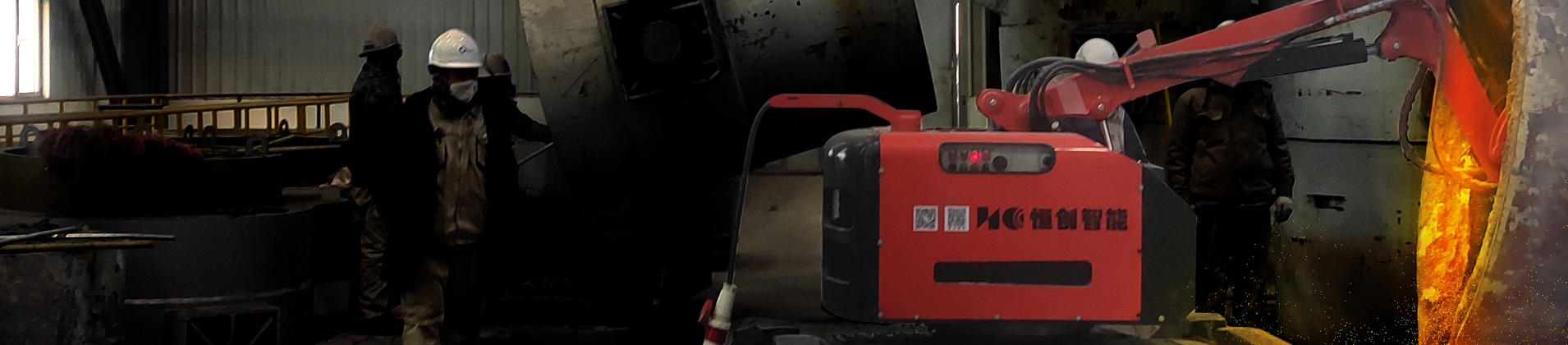
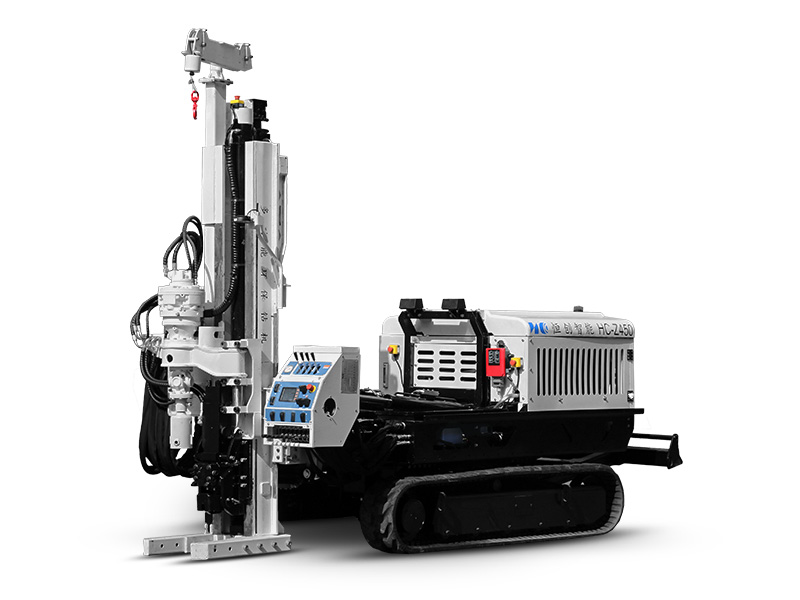
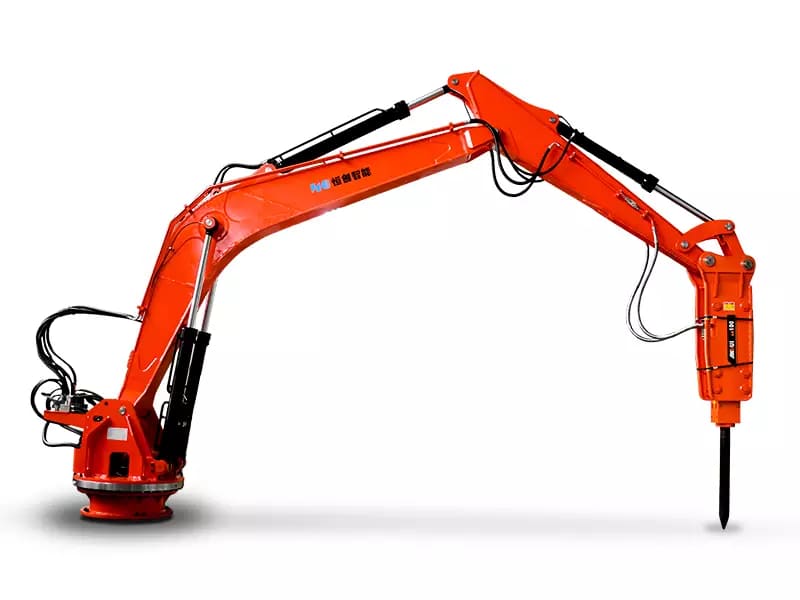
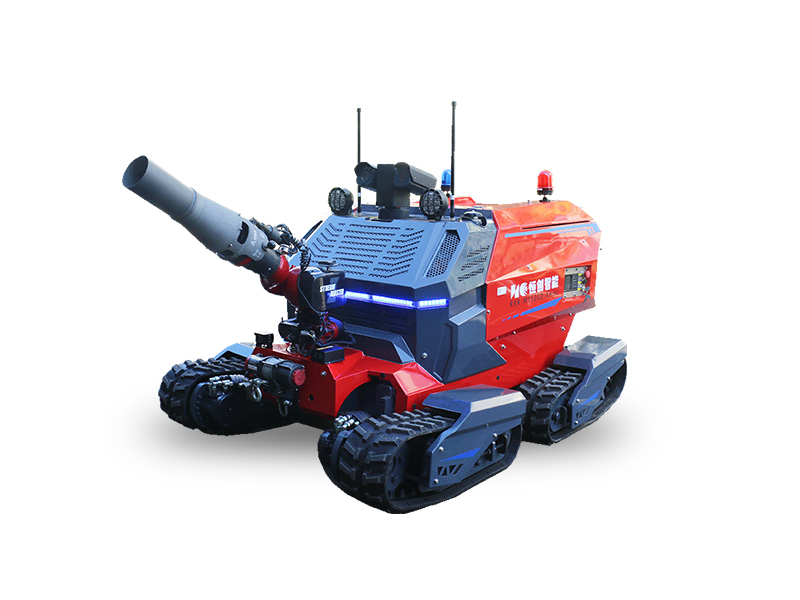
Tunnel projects involve more than simply cutting through rock. In most underground works, progress depends on three linked operations: excavation, scaling, and rock breaking. Each process has different technical goals, safety risks, and equipment demands. That is why the demolition robot is becoming an increasingly practical solution in modern tunneling. Compared with larger conventional machines, a demolition robot can work in confined underground conditions, switch tools quickly, and complete multiple tasks with greater control.
Excavation is the process of removing rock, soil, or concrete to create the required tunnel profile. Depending on the geology and project method, excavation may involve mechanical breaking, partial trimming, bench removal, cross passage opening, or enlargement of specific areas. In many cases, demolition robot tunnel excavation is valuable where precise removal is needed and access is limited.
Scaling is the removal of loose or unstable rock from the tunnel crown and walls after blasting or excavation. This is a critical safety step. If loose material is left in place, it can fall unexpectedly and injure workers, damage equipment, or interrupt operations. Robotic scaling in tunneling reduces the need for personnel to stand close to unstable rock and allows controlled removal from a safer distance.
Rock breaking is used when oversized rock, hard formations, or localized sections cannot be removed efficiently by the main excavation method alone. This may happen in tunnel faces, sidewall trimming, invert correction, or areas where secondary breaking is required. A rock breaking robot or underground rock breaking machine is especially useful when the operator needs accuracy, reach, and remote operation rather than bulk excavation capacity.
Although excavation, scaling, and rock breaking are related, each task places different demands on tunnel excavation equipment.
For excavation work, the machine must provide:
High breakout force for hard material removal
Stable boom control for profile shaping
Compact dimensions for underground mobility
Good visibility or remote-control capability in restricted areas
Compatibility with hydraulic breakers, buckets, or cutters depending on the project
A demolition robot used for excavation is not meant to replace a large production excavator in all situations. Instead, it is highly effective for selective excavation, tunnel enlargement, side niches, cross passages, and areas where maneuverability matters more than raw volume.
For scaling, the priorities are different:
Long and flexible boom reach to access the crown and upper walls
Precise attachment control to remove loose rock without overbreaking
Remote operation to keep personnel away from hazardous zones
Stable chassis for safe operation on uneven underground surfaces
A scaling robot for tunnels must emphasize control and operator safety. The goal is not mass removal, but careful detachment of unstable rock with minimal unnecessary disturbance to the surrounding surface.
For rock breaking tasks, the equipment must offer:
Sufficient hammer energy for secondary breaking
Durable hydraulic system for continuous impact work
Strong boom structure to withstand repeated shock loads
Precision in confined spaces where overbreak must be limited
Quick repositioning in narrow tunnel headings
This is where a rock breaking robot is particularly useful. It combines controlled impact with compact access, making it suitable for headings, underground chambers, and localized hard rock sections.
One of the strongest advantages of a demolition robot is its ability to change functions through different attachments. Instead of bringing separate machines for every stage, contractors can use one base unit and switch tools according to the job.
Typical attachment changes include:
Hydraulic breaker for rock breaking and selective excavation
Scaling tool or scaling bar for loose rock removal
Bucket for material handling or small-scale excavation
Cutter head or milling attachment for trimming concrete or softer formations
This approach improves site flexibility. A contractor may use the machine for excavation in one shift, switch to scaling after blasting, and then return to rock breaking where oversized material remains. In underground work, where transport, setup, and access all consume time, this multi-function capability can reduce idle periods and improve equipment utilization.
Tool changes also help simplify logistics. Instead of moving several dedicated machines through restricted tunnel access points, teams can rely on one compact demolition robot platform with interchangeable tools. That is often more practical in utility tunnels, railway tunnels, metro works, and narrow drill-and-blast sections.
A demolition robot is not simply a smaller excavator. Its design philosophy is different, especially for underground use.
Traditional excavators and large breakers require more working room, larger turning areas, and easier transport access. In tunnels, those conditions are not always available. A demolition robot is generally more compact, which helps it enter confined headings, cross passages, and low-clearance work zones.
Conventional rock breaking often puts operators and workers closer to unstable faces or falling material. A demolition robot is commonly operated remotely, allowing the operator to stand farther from the danger zone. This is a major advantage in scaling and secondary breaking.
Large excavators are efficient for bulk excavation, but they are less suitable for detailed trimming or selective removal in tight underground areas. A demolition robot offers finer boom control, which is important for profile correction, localized excavation, and robotic scaling in tunneling.
Traditional equipment is often task-specific. One machine excavates, another scales, another breaks oversized rock. A demolition robot can shift between these roles with attachment changes, reducing equipment overlap on site.
It is important to be practical. A demolition robot does not always match the production capacity of a full-size excavator in open or spacious sections. For large-volume bulk removal, traditional heavy equipment may still be more efficient. The value of the demolition robot is strongest where space, safety, precision, and multi-functionality are critical.
Tunnel contractors increasingly need equipment that can adapt to different geological conditions and changing site requirements. In that context, the demolition robot has become more than a niche machine. It is now a versatile solution for demolition robot tunnel excavation, scaling, and controlled rock breaking in underground environments.
By combining compact design, remote operation, and fast attachment switching, the machine helps improve safety, reduce equipment changeover, and support more accurate underground work. For projects where the working area is tight and risk exposure is high, that combination offers clear operational value.
Not completely. A demolition robot is best for selective excavation, scaling, trimming, and localized rock breaking. For large-volume bulk excavation, a traditional excavator may still be more productive.
Scaling removes loose rock that could fall after excavation or blasting. Using a robot keeps workers farther from unstable tunnel surfaces and provides more controlled removal.
Common attachments include hydraulic breakers, scaling tools, buckets, and cutter heads. These allow one machine to perform excavation, scaling, and rock breaking tasks in different tunnel stages.
For more information about demolition robot solutions and underground applications, visit https://www.hcrot.com/