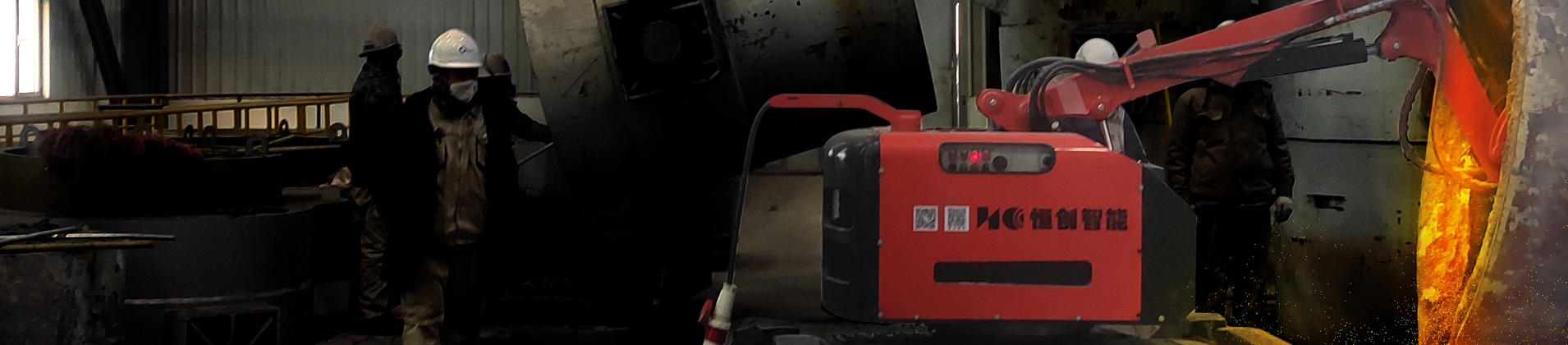
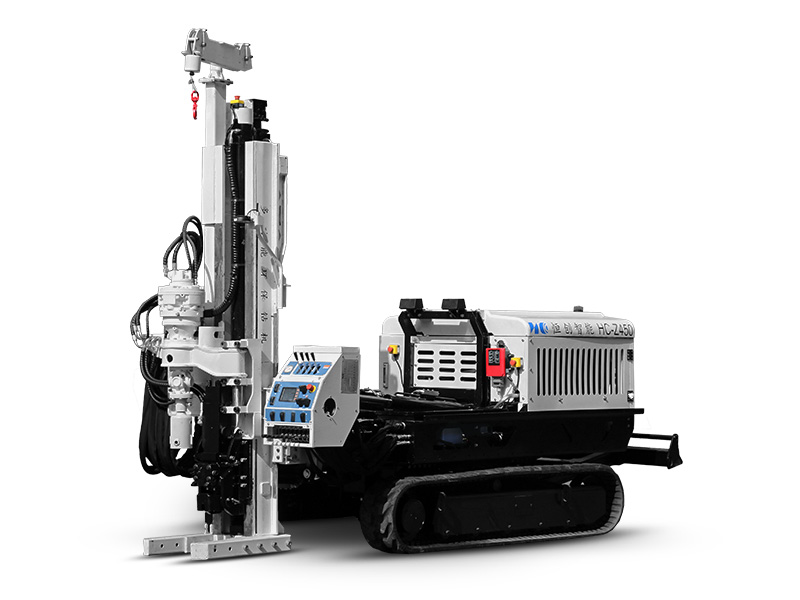
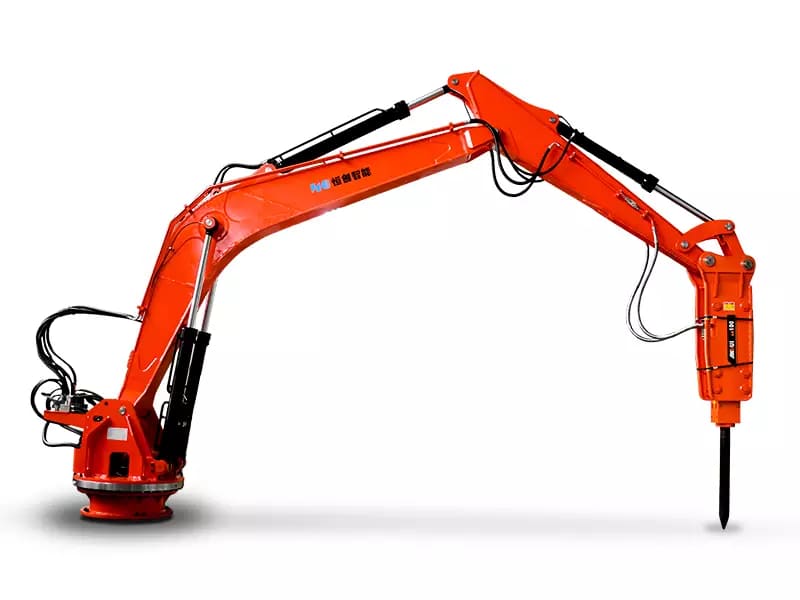
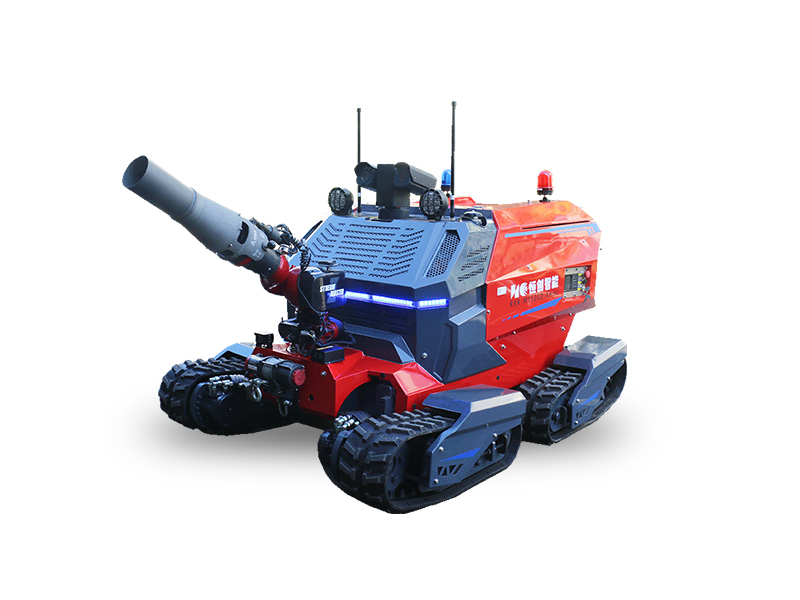
In modern underground construction, the demolition robot has evolved from a single-purpose machine into a multi-functional platform. Its true value lies not only in compact size and remote control, but in the wide range of demolition robot attachments it can utilize. From excavation to support installation, the right combination of tools allows contractors to execute multiple processes with a single machine, improving both safety and productivity.
This article explains the most important robotic tunneling attachments, their working conditions, and how to optimize their use across different tunnel construction stages.
The breaker is the most commonly used attachment for a demolition robot.
Working conditions:
Hard rock excavation
Secondary rock breaking after blasting
Oversized rock removal in confined tunnel areas
Key advantages:
High impact energy for efficient rock fragmentation
Suitable for narrow spaces where excavators cannot operate
Reduced manual intervention in hazardous zones
A tunnel drilling attachment transforms the robot into a precision drilling unit.
Working conditions:
Rock bolt hole drilling
Blast hole preparation
Anchor installation in tunnel walls and ceilings
Key advantages:
Accurate positioning in confined environments
Reduced need for separate jumbo drills in small tunnels
Improves safety by enabling remote drilling
Scaling is critical after blasting or excavation.
Working conditions:
Removal of loose rock from tunnel crown and walls
Post-blasting safety operations
Preventing rockfall hazards
Key advantages:
Enhances tunnel safety before personnel re-entry
Reaches overhead areas safely
Reduces reliance on manual scaling
A scabbler (or milling head) is used for surface treatment.
Working conditions:
Concrete surface roughening before shotcrete
Precise trimming of tunnel profiles
Removal of damaged lining
Key advantages:
High precision for surface preparation
Improves bonding quality for shotcrete
Reduces dust compared to manual methods
Though not always highlighted, the bucket is essential for material handling.
Working conditions:
Loose material removal
Small-scale excavation
Debris clearing in confined tunnels
Key advantages:
Enables multi-tasking without additional loaders
Efficient in narrow access tunnels
Supports continuous workflow
The shotcrete attachment robot is crucial for tunnel support.
Working conditions:
Application of sprayed concrete lining
Initial tunnel stabilization
Reinforcement after excavation
Key advantages:
Consistent and uniform spraying
Reduced rebound and material waste
Improved operator safety (remote operation away from dust and rebound zones)
A demolition robot’s base unit provides mobility and hydraulic power, but attachments determine its real capabilities.
Core principle:One base machine + multiple attachments = multiple construction processes
This modular approach allows:
Replacement of several specialized machines
Reduced equipment investment
Greater flexibility across changing site conditions
In tunnel projects where space, logistics, and safety constraints are strict, this versatility becomes a major competitive advantage.
Frequent equipment changes are one of the main causes of downtime in tunnel construction.
Strategies to minimize switching:
Use quick coupling systems for rapid attachment replacement
Plan workflows to group similar operations (e.g., drilling + scaling in sequence)
Select multi-functional attachments when possible
Train operators for efficient attachment handling
Operational benefit:
Reduced idle time
Lower labor costs
Improved project scheduling reliability
Different tunnel construction phases require different combinations of tunnel construction robot tools.
| Project Stage | Recommended Attachments Combination |
|---|---|
| Initial Excavation | Breaker + Bucket |
| Drilling & Blasting Prep | Tunnel drilling attachment |
| Post-Blast Safety | Scaling attachment |
| Profile Shaping | Scabbler / Milling attachment |
| Support Installation | Shotcrete attachment robot |
| Maintenance & Repair | Breaker + Scabbler |
Insight:
Instead of deploying multiple machines, contractors can rotate attachments on a single demolition robot, significantly improving efficiency in confined underground environments.
To maximize performance, consider:
Tunnel size: smaller tunnels favor compact robots with multi-use attachments
Rock hardness: determines breaker and drilling requirements
Project timeline: tighter schedules benefit from reduced equipment switching
Safety requirements: scaling and shotcrete attachments become critical
A well-planned attachment strategy can reduce overall project costs while increasing safety and productivity.
1. Can one demolition robot handle all tunnel construction tasks?
Yes, with the right combination of demolition robot attachments, a single machine can perform drilling, scaling, breaking, and shotcreting tasks, though large-scale projects may still require specialized equipment.
2. What is the most important attachment in tunneling?
The breaker is typically the most frequently used, but scaling and shotcrete attachments are equally critical for safety and structural stability.
3. How long does it take to switch attachments?
With modern quick couplers, attachment changes can be completed in a few minutes, significantly reducing downtime compared to traditional equipment changes.
The evolution of the demolition robot into a multi-functional platform has transformed tunnel construction workflows. By leveraging advanced robotic tunneling attachments—including breaker, drilling, scaling, scabbler, bucket, and shotcrete tools—contractors can execute multiple processes efficiently with a single machine.
This not only improves productivity but also enhances safety and reduces operational complexity in confined underground environments.
To explore more about demolition robot solutions and attachment configurations for your tunnel projects, visit: https://www.hcrot.com/