In modern mining, quarrying, and bulk material handling industries, efficient rock fragmentation is critical to productivity and safety. One of the most essential pieces of equipment used for this purpose is the rock breaker. Whether installed in mines, aggregate plants, or crushing stations, a breaker machine plays a vital role in reducing oversized rocks, preventing blockages, and ensuring continuous material flow. This article provides a comprehensive explanation of the working principle of a breaker machine, with a particular focus on systems such as the Rockbreaker Boom System, stationary rock breaker, Pedestal Boom System, and other related rock breaker configurations.
A rock breaker is a mechanical device designed to break large rocks, boulders, or oversized materials into smaller, manageable pieces. It is commonly used in conjunction with primary crushers, such as jaw crushers or gyratory crushers, where oversized rocks can cause blockages and downtime.
Unlike blasting or manual breaking, a breaker machine delivers controlled, repetitive impact energy to fracture rocks efficiently and safely. In many fixed installations, the rock breaker is mounted on a pedestal or boom, forming a complete Rockbreaker Boom System.
To understand the working principle of a breaker machine, it is essential to first understand its core components. A typical rock breaker system consists of the following:
The hydraulic breaker is the heart of the rock breaker. It converts hydraulic energy into mechanical impact energy, which is transferred directly to the rock surface.
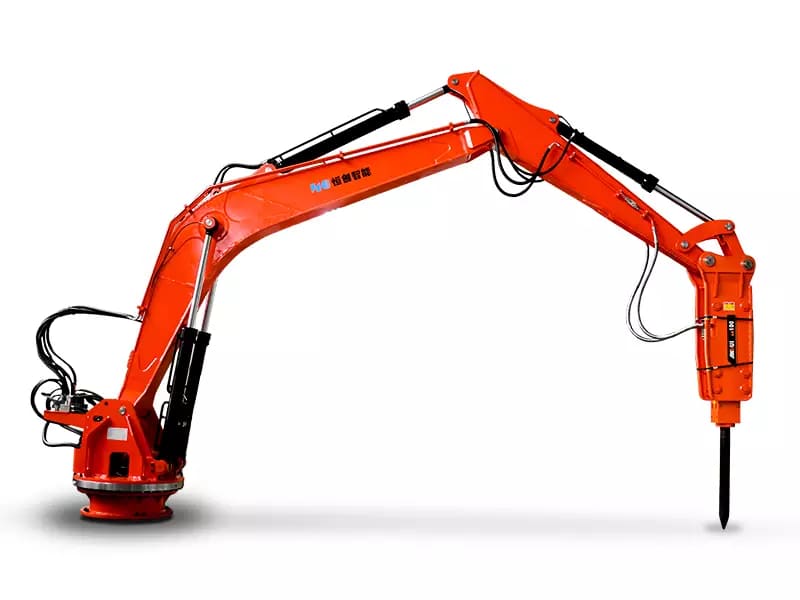
The boom is an articulated arm that positions the breaker precisely over the target rock. In a Pedestal Boom System, the boom is mounted on a fixed base, allowing it to cover a defined working area.
A stationary rock breaker uses a rigid pedestal anchored to concrete or steel structures. This provides stability and allows the breaker machine to operate continuously in harsh conditions.
The hydraulic power unit supplies pressurized oil to drive the breaker machine. It typically includes pumps, valves, filters, oil coolers, and a control system.
The control system allows operators to maneuver the Rockbreaker Boom System, adjust impact force, and ensure safe operation.
The working principle of a breaker machine is based on hydraulic impact energy combined with precise mechanical control. Below is a step-by-step explanation of how a rock breaker operates.
The process begins at the hydraulic power unit. The HPU generates high-pressure hydraulic oil using pumps driven by electric motors or diesel engines. This pressurized oil is directed through control valves to the breaker machine.
Inside the hydraulic breaker, hydraulic pressure acts on a piston. When oil flows into the pressure chamber, it drives the piston upward. Once the pressure reaches a set threshold, the oil is redirected, allowing the piston to accelerate downward rapidly.
This downward motion creates a powerful impact, transferring kinetic energy to the tool (chisel or moil point) at the end of the breaker machine.
The tool makes direct contact with the rock surface. The repeated high-energy blows generate compressive stress waves inside the rock. When these stress waves exceed the rock’s internal strength, cracks form and propagate, causing the rock to fracture.
This principle of controlled stress concentration is what makes the rock breaker far more efficient and predictable than uncontrolled methods such as blasting.
The Rockbreaker Boom System allows the operator to position the breaker machine accurately over the rock. Hydraulic cylinders in the boom provide rotation, extension, and lifting movements, ensuring the breaker hits the rock at the optimal angle.
In a Pedestal Boom System, the working envelope is carefully designed to cover crusher inlets, grizzlies, or hoppers where blockages typically occur.
The breaker machine repeats this cycle hundreds of times per minute. The frequency and impact energy can be adjusted depending on rock hardness, size, and application requirements.
Different applications require different configurations of rock breaker systems. The working principle remains the same, but the installation and scale vary.
A stationary rock breaker is permanently installed at a fixed location, such as above a crusher feed opening. It is ideal for high-throughput operations where consistent rock breaking is required.
The Pedestal Boom System is one of the most widely used configurations. It combines a fixed pedestal, a multi-section boom, and a hydraulic breaker machine. This system offers excellent reach, stability, and durability.
Mobile breaker machines are mounted on tracked or wheeled carriers. While the working principle is identical, mobility allows them to be used across multiple sites.
The use of a rock breaker in crushing and mining operations offers several key advantages:
Prevents crusher blockages, reducing downtime
Improves safety by eliminating manual rock breaking
Enhances productivity by maintaining steady material flow
Reduces equipment wear by controlling rock size before crushing
A properly designed Rockbreaker Boom System ensures that oversized rocks are dealt with quickly and efficiently, keeping the entire production line running smoothly.
Although the working principle of a breaker machine is straightforward, several factors influence its performance:
Hardness, abrasiveness, and fracture characteristics of the rock significantly affect breaking efficiency.
Correct hydraulic settings are essential. Too little pressure reduces effectiveness, while excessive pressure can damage the breaker machine.
Different tools are used depending on the application. Chisels, blunt tools, and moil points each serve different breaking purposes.
Even with advanced automation, skilled operation of the rock breaker and boom system improves efficiency and extends equipment life.
Regular maintenance is crucial for ensuring long-term performance of a breaker machine. Key practices include:
Monitoring hydraulic oil cleanliness
Inspecting wear parts regularly
Ensuring proper lubrication
Checking boom pins and joints for wear
A well-maintained stationary rock breaker or Pedestal Boom System can operate reliably for many years under extreme conditions.
Breaker machines are widely used across multiple industries, including:
Mining (underground and open-pit)
Quarrying and aggregate processing
Cement plants
Metallurgical and steel plants
Recycling and demolition
In all these applications, the rock breaker plays a critical role in handling oversized materials safely and efficiently.
Modern rock breaker systems are evolving with advances in automation and monitoring. Smart Rockbreaker Boom System designs now include:
Remote and automated operation
Condition monitoring sensors
Energy-efficient hydraulic systems
Enhanced safety interlocks
These innovations further optimize the working principle of the breaker machine while reducing operational risks and costs.
The working principle of a breaker machine is based on converting hydraulic energy into powerful mechanical impacts that fracture rock efficiently. By combining a hydraulic breaker with a precisely controlled boom and a stable pedestal, modern rock breaker systems provide a safe, reliable, and productive solution for handling oversized materials. Whether used as a stationary rock breaker, Pedestal Boom System, or mobile configuration, the rock breaker remains an indispensable tool in today’s heavy industries.
Q1: What is the main working principle of a rock breaker?
The main working principle of a rock breaker is the conversion of hydraulic pressure into mechanical impact energy, which is repeatedly applied to rocks to induce fractures and break them into smaller pieces.
Q2: How does a Pedestal Boom System improve breaker machine efficiency?
A Pedestal Boom System improves breaker machine efficiency by providing stable support and precise positioning, allowing the rock breaker to deliver impact energy at the optimal angle and location.
Q3: Where is a stationary rock breaker typically used?
A stationary rock breaker is typically used at fixed locations such as crusher inlets, hoppers, and grizzlies, where oversized rocks frequently cause blockages and disrupt material flow.