In mining, quarrying, and large-scale aggregate processing, material flow reliability is everything. When oversized rocks block crushers, productivity drops instantly. This is where the Rockbreaker Boom System becomes a mission-critical piece of equipment. Understanding the capacity of a rock breaker is not just about hammer power—it involves reach, duty class, rock size, crusher opening, and operating conditions. This article explains capacity in detail, while also clarifying how a stationary rock breaker, pedestal rock breaker boom system, and Pedestal Boom System are selected and rated for real-world operations.
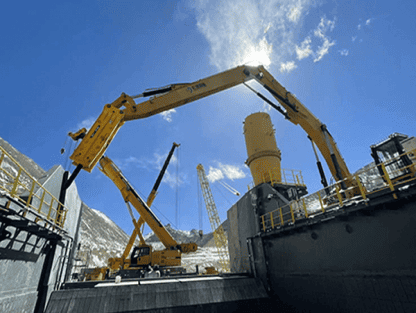
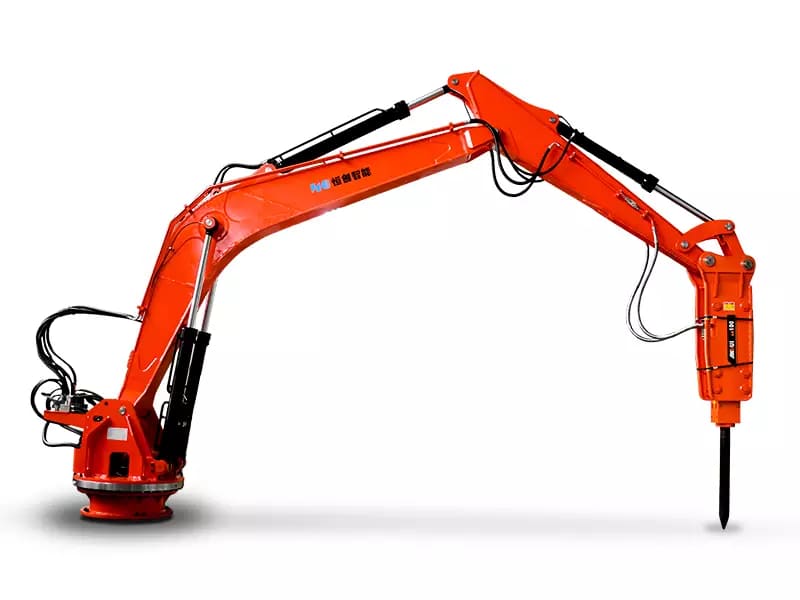
A Rockbreaker Boom System is a hydraulically operated mechanical arm mounted near a crusher, typically at the primary crushing stage. It is designed to position a hydraulic breaker precisely to break oversized rocks and clear blockages.
Unlike mobile breakers, a Rockbreaker Boom System is permanently installed, giving it greater stability, reach, and durability. In high-tonnage environments, the Rockbreaker Boom System is essential for maintaining continuous material flow and preventing costly downtime.
The system usually consists of:
A pedestal or base structure
A multi-section boom (primary, secondary, sometimes tertiary)
A hydraulic hammer or breaker
Power unit and control system
When discussing the capacity of a Rockbreaker Boom System, we must look beyond simple hammer energy.
The capacity of a Rockbreaker Boom System is not measured in tons per hour like crushers. Instead, capacity is defined by the maximum rock size, hardness, and frequency the system can handle effectively without excessive wear or operational delays.
Key capacity indicators include:
Maximum rock size (diameter or weight)
Impact energy of the breaker (kJ)
Working radius and reach
Crusher opening coverage
Duty cycle (light, medium, heavy, extreme)
A properly sized Rockbreaker Boom System ensures that every area of the crusher mouth can be reached safely and efficiently.
One of the most critical capacity factors for a Rockbreaker Boom System is the maximum rock size it can handle. As a rule of thumb:
Small systems handle rocks up to 600 mm
Medium systems handle rocks up to 1,000 mm
Large systems handle rocks exceeding 1,500 mm
The breaker must deliver enough impact energy to fracture the rock efficiently. If the breaker is undersized, the Rockbreaker Boom System will spend too much time on each blockage, reducing overall plant throughput.
This is why many operations prefer a heavy-duty pedestal rock breaker boom system for primary crushers.
The hydraulic breaker attached to a Rockbreaker Boom System defines much of its capacity. Breakers are typically rated by impact energy (kJ) and frequency (blows per minute).
Duty classes include:
Light-duty (secondary breaking)
Medium-duty (general quarry work)
Heavy-duty (primary crusher blockages)
Extreme-duty (hard rock mining)
A Pedestal Boom System designed for heavy or extreme duty can operate continuously under harsh conditions without structural fatigue. Capacity increases significantly with higher duty ratings.
Another often overlooked factor is reach. A Rockbreaker Boom System must cover the entire crusher opening, including corners where rocks frequently wedge.
Reach capacity includes:
Horizontal reach (meters)
Vertical working depth
Swing radius
If a stationary rock breaker cannot reach all blockage zones, capacity is effectively reduced—even if the breaker itself is powerful.
That’s why boom geometry is as important as hammer size when selecting a Rockbreaker Boom System.
The capacity of a Rockbreaker Boom System must match the crusher type:
Jaw crushers require long reach and strong breakers
Gyratory crushers need wide coverage and vertical reach
Impact crushers require faster, more precise movements
A mismatch leads to inefficient breaking cycles. A properly engineered pedestal rock breaker boom system ensures that the breaker works at optimal angles, maximizing effective capacity.
Rock hardness dramatically influences capacity. Granite, basalt, and quartzite demand more energy than limestone or sandstone.
In hard rock environments:
Larger breakers are required
Stronger booms with reinforced structures are necessary
Cycle times increase
A heavy-duty Rockbreaker Boom System compensates for hardness with higher impact energy and structural rigidity, maintaining consistent capacity even in abrasive conditions.
Modern Rockbreaker Boom System installations increasingly use automation. Automated or semi-remote systems improve effective capacity by reducing response time and operator fatigue.
Benefits include:
Faster blockage response
More precise breaker positioning
Improved safety
Consistent breaking cycles
An automated Pedestal Boom System can outperform a manually operated system even with the same mechanical specifications.
While capacity varies by application, real-world examples help illustrate:
Quarry jaw crusher:
A Rockbreaker Boom System handles rocks up to 1,200 mm, clearing blockages in under 2 minutes.
Underground mine:
A heavy-duty stationary rock breaker manages continuous blockages with rocks exceeding 1,500 mm.
Aggregate plant:
A medium pedestal rock breaker boom system ensures uninterrupted flow at 500–800 tons per hour crusher throughput.
In all cases, the system’s capacity supports the crusher rather than limiting it.
Selecting the correct Rockbreaker Boom System capacity requires analyzing:
Maximum feed size
Crusher geometry
Rock hardness
Required uptime
Safety constraints
Oversizing slightly is often recommended. An under-capacity Rockbreaker Boom System becomes a bottleneck, while a properly sized Pedestal Boom System adds long-term reliability and operational flexibility.
So, what is the capacity of a rock breaker? In practical terms, the capacity of a Rockbreaker Boom System is its ability to break and clear the largest expected rocks quickly, safely, and consistently—without becoming the weak link in the crushing circuit.
A well-designed Rockbreaker Boom System, whether configured as a stationary rock breaker, pedestal rock breaker boom system, or full Pedestal Boom System, is an investment in uptime, safety, and long-term productivity.
1. How do I determine the correct Rockbreaker Boom System capacity for my crusher?
The correct capacity depends on maximum rock size, crusher opening dimensions, rock hardness, and duty cycle. A properly engineered Rockbreaker Boom System should fully cover the crusher and handle the largest expected boulders efficiently.
2. Is a stationary rock breaker suitable for high-capacity mining operations?
Yes. A heavy-duty stationary rock breaker, especially a pedestal rock breaker boom system, is ideal for high-capacity mining because it offers stability, reach, and continuous operation under extreme conditions.
3. Can increasing breaker size always improve Rockbreaker Boom System capacity?
Not always. While larger breakers increase impact energy, overall Rockbreaker Boom System capacity also depends on boom reach, structural strength, and crusher geometry. Balanced system design delivers the best results.