Cement plants operate in harsh, high-temperature environments where refractory linings protect kilns, preheaters, coolers, and other process equipment from thermal stress and abrasion. Over time, these refractory materials crack, spall, loosen, or wear out, making periodic removal and replacement essential. In this context, a demolition robot has become one of the most effective tools for modern cement plant maintenance.
A demolition robot is a compact, remote-controlled machine designed for breaking, chipping, and removing hard materials in hazardous or confined spaces. For cement plants, it offers a safer and more controlled method for refractory removal than traditional manual demolition or oversized equipment. As maintenance teams seek to reduce downtime, improve worker safety, and increase precision, the demolition robot is increasingly becoming the preferred solution.
Refractory removal in a cement plant is not a simple demolition task. It usually takes place inside hot, dusty, space-restricted structures such as rotary kilns, tertiary air ducts, cyclone towers, clinker coolers, and calciner systems. These areas create several operational challenges.
First, worker safety is a major concern. Residual heat, unstable lining sections, falling debris, dust exposure, and awkward working positions all increase risk. Second, refractory materials are extremely hard and bonded tightly to steel shells or concrete substrates, making removal labor-intensive. Third, shutdown windows in cement plants are usually short. Maintenance teams must complete demolition, cleaning, inspection, and relining quickly to restore production.
This is exactly where a demolition robot provides a clear advantage.
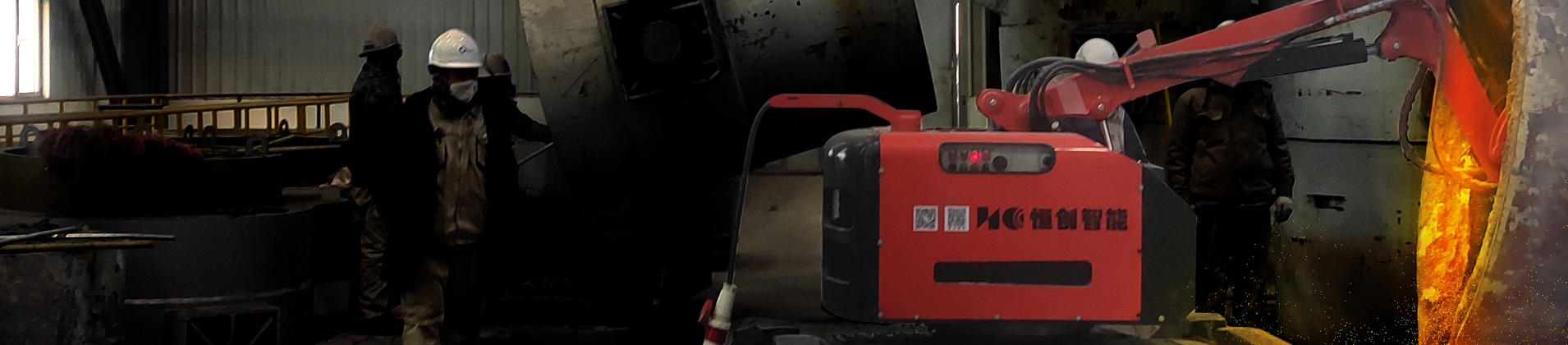
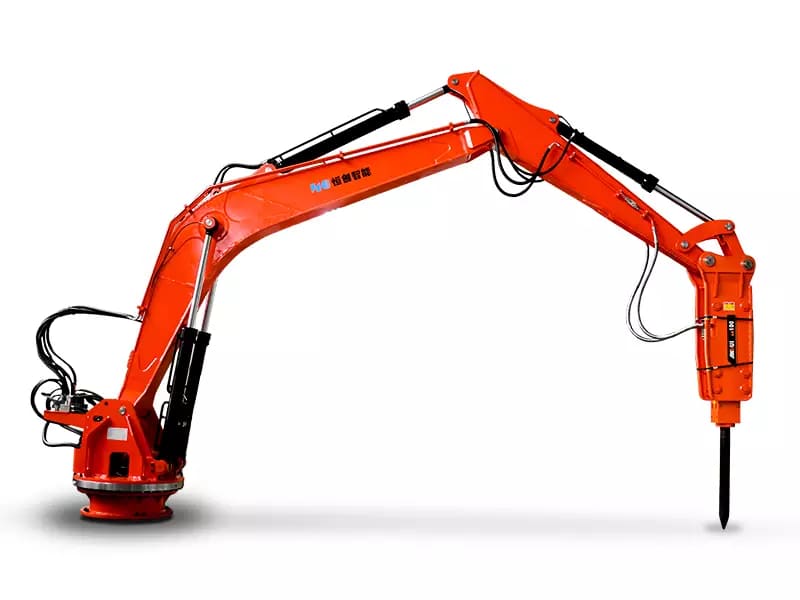
In cement plant refractory maintenance, a demolition robot is typically equipped with a hydraulic breaker, scalper, or bucket, depending on the task. The machine is remotely controlled by an operator positioned at a safe distance. It enters the work zone and methodically removes damaged refractory with controlled impact force.
Typical cement plant applications include:
Rotary kiln refractory removal
Clinker cooler lining demolition
Preheater tower coating and refractory breakout
Calciner and duct refractory stripping
Cyclone inlet and outlet lining removal
Maintenance in confined and elevated industrial spaces
Because the demolition robot is compact and highly maneuverable, it can work in areas where conventional excavators cannot enter. Its boom system allows accurate reach and controlled force, reducing the risk of damaging surrounding steel structures or process equipment.
The biggest benefit of a demolition robot is that it removes personnel from the most dangerous zone. Instead of sending workers directly into unstable, dusty, or heat-affected areas with jackhammers, the operator controls the machine remotely. This significantly reduces exposure to falling refractory, vibration, noise, and airborne dust.
Manual refractory removal is slow and physically demanding. A demolition robot can maintain consistent breaking force for long periods and complete work faster than handheld tools. This helps shorten kiln shutdowns and reduces maintenance-related production losses.
In cement plant maintenance, not all material should be demolished. Sometimes the objective is to remove only worn refractory while protecting anchors, shell plates, or adjacent structures. A demolition robot offers much better control than large heavy equipment, making selective demolition easier.
Cement plants often have narrow passages, platforms, and restricted internal geometries. A demolition robot is specifically suited for these tight working conditions. Its compact footprint and flexible arm movement allow it to operate where larger machines are impractical.
| Method | Safety | Efficiency | Precision | Suitability for Cement Plants |
|---|---|---|---|---|
| Manual jackhammering | Low | Low | Medium | Limited, high labor intensity |
| Large excavator | Medium | High | Low | Poor for confined spaces |
| Demolition robot | High | High | High | Excellent |
This comparison shows why the demolition robot is increasingly used during cement plant shutdown maintenance. It combines the productivity of mechanized demolition with the control needed for industrial refractory work.
Not every demolition robot is suitable for every cement plant maintenance task. Selection should be based on several technical factors:
The dimensions of kiln entries, ducts, and platforms determine the allowable machine width, height, and turning radius.
The robot must reach sidewalls, overhead sections, and floor linings without constant repositioning.
Different refractory conditions require different attachments. A hydraulic breaker is common for hard bonded material, while a scalper may be better for layered or partially loosened lining.
Electric-powered demolition robot systems are often preferred indoors because they reduce exhaust emissions and are suitable for enclosed industrial environments.
In cement plants, equipment often needs to move between levels or through access doors. Transport weight and setup speed matter during shutdown periods.
To maximize the value of a demolition robot in cement plant maintenance, operators and contractors should follow a structured approach.
Begin with a site survey to identify refractory thickness, equipment geometry, access limitations, and potential hazards. Confirm that the plant is fully isolated and cooled to the required maintenance condition. Select the proper tool attachment for the lining type and substrate. During removal, work in a controlled pattern rather than using excessive impact in one area. This improves efficiency and reduces the chance of damaging anchors or shell surfaces.
Dust management is also important. Although the demolition robot improves safety, refractory breakout still creates airborne particles. Plants should use ventilation, dust suppression, and proper PPE for surrounding personnel.
The cement industry is under constant pressure to improve plant availability, reduce maintenance risk, and control labor costs. A demolition robot directly supports these goals. It enables faster shutdown execution, lowers the physical burden on maintenance crews, and helps standardize the quality of refractory removal work.
For cement plants managing aging kilns, rising safety standards, and tighter outage schedules, the demolition robot is no longer just a specialized option. It is increasingly a practical maintenance asset.
The main advantage is safer and more efficient demolition. A demolition robot allows remote operation in hot, dusty, and confined areas while delivering strong and controlled breaking performance.
Yes. A demolition robot is commonly used for rotary kiln refractory removal, provided the machine dimensions, reach, and power configuration match the kiln access and internal working conditions.
In most cases, yes. A demolition robot usually offers better safety, faster removal speed, less operator fatigue, and more consistent demolition quality during planned maintenance shutdowns.
For cement plants looking to improve refractory removal safety and maintenance efficiency, choosing the right demolition robot can make a major difference. Learn more at: https://www.hcrot.com/