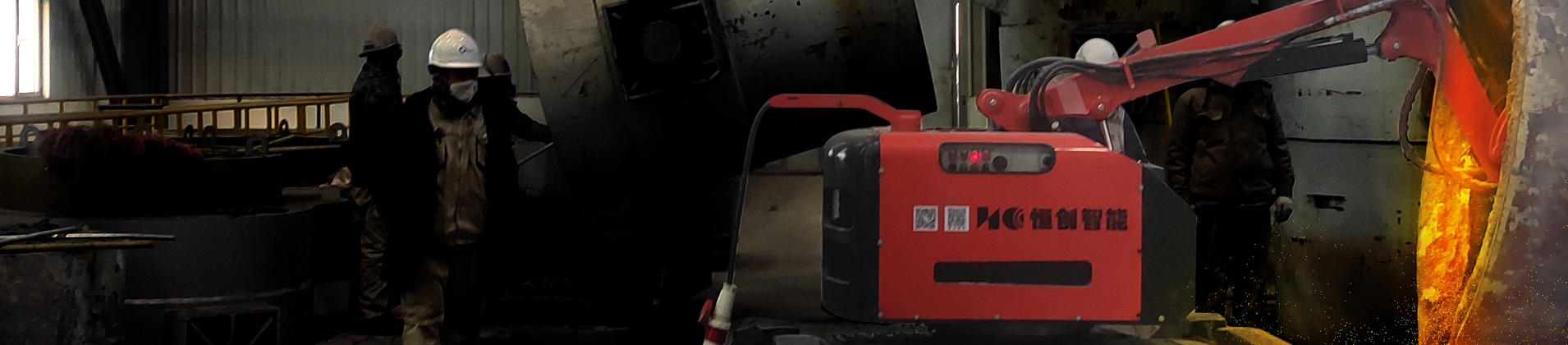
In cement plant maintenance, demolition work is unavoidable. Refractory removal, kiln outlet cleaning, cyclone repair, coating removal, and dismantling damaged concrete or steel structures are all routine but high-risk tasks. For decades, many plants have relied on traditional manual demolition using jackhammers, handheld breakers, cutting tools, and scaffolding crews. Today, a demolition robot offers a safer and more efficient alternative for many of these operations.
This article compares demolition robot methods with traditional manual demolition in cement plant operations, focusing on safety, productivity, precision, downtime, and long-term value.
Cement plants are harsh industrial environments. Demolition tasks often take place in:
confined spaces
high-temperature zones after shutdown
dusty and abrasive conditions
elevated work areas
structurally restricted maintenance zones
Manual demolition in these settings exposes workers to falling debris, vibration, heat stress, silica dust, and awkward working positions. It is also difficult to maintain consistent speed and precision when operators are physically inside the hazard zone.
A demolition robot changes this model by allowing the operator to control the machine remotely from a safer distance.
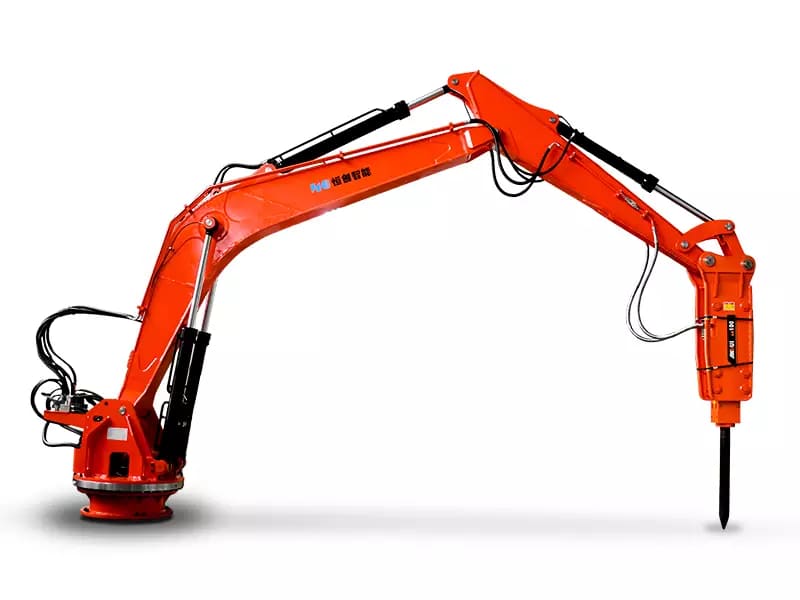
A demolition robot is a compact, remote-controlled machine equipped with hydraulic breakers, crushers, buckets, or scalers. In cement plant operations, it is commonly used for:
refractory removal in kilns and preheaters
demolition of damaged concrete linings
cleaning build-ups in process areas
dismantling old platforms or internal structures
selective demolition during shutdown maintenance
Because a demolition robot is smaller than conventional excavators and more powerful than handheld tools, it fits well in industrial maintenance environments where access is limited and precision matters.
The core difference is simple: manual demolition depends on workers being close to the breaking point, while a demolition robot allows the work to be done with greater distance, higher force, and better control.
| Factor | Demolition robot | Traditional manual demolition |
|---|---|---|
| Worker safety | Remote operation reduces exposure to debris, dust, and collapse risk | Workers remain close to impact zone |
| Productivity | Higher breaking force and longer continuous operation | Slower, fatigue-dependent output |
| Precision | Controlled, selective demolition possible | More difficult to keep uniform accuracy |
| Labor demand | Fewer workers needed at the demolition point | More frontline labor required |
| Access in confined spaces | Strong for tight industrial environments | Possible, but slower and more physically demanding |
| Vibration exposure | Mostly transferred to machine, not operator body | High direct exposure for workers |
| Downtime impact | Often shorter shutdown duration | Longer execution time in many tasks |
| Initial investment | Higher equipment cost | Lower initial tool cost |
Safety is the strongest argument for using a demolition robot in cement plant operations. Cement plants are full of maintenance scenarios where manual demolition places people directly inside dangerous zones.
With traditional methods, workers may have to stand on platforms or inside partially enclosed spaces while operating heavy handheld tools. This increases the risk of injury from flying material, unstable surfaces, repetitive strain, and prolonged dust exposure.
A demolition robot improves safety by:
moving the operator away from the immediate danger zone
reducing direct exposure to falling fragments
lowering the physical strain of handheld demolition
minimizing worker time spent in confined or unstable areas
In shutdown projects, this can also simplify safety planning because fewer people need to enter the highest-risk work zones.
Cement plants measure maintenance success not only by repair quality but also by shutdown duration. Every additional hour of downtime can affect production schedules and operating costs.
A demolition robot usually outperforms manual demolition in repetitive, heavy-duty removal tasks. It delivers stable hydraulic power over longer periods without the fatigue limits of hand tools. That makes it especially useful for large refractory removal jobs or thick concrete demolition.
| Maintenance criterion | Demolition robot | Manual demolition |
|---|---|---|
| Continuous work capacity | High | Moderate |
| Fatigue effect on output | Low | High |
| Suitability for large refractory removal | Excellent | Limited by labor intensity |
| Consistency over long shifts | Strong | Often declines over time |
| Shutdown acceleration potential | High | Moderate to low |
Manual demolition may still be suitable for very small touch-up jobs or highly localized finishing work, but for larger removal volumes, a demolition robot typically offers faster execution.
In cement plants, not every demolition task is full removal. Many jobs require selective demolition, where only damaged lining, concrete, or built-up material should be removed without harming nearby equipment or structures.
A demolition robot offers better positioning and controlled force application than crews using handheld breakers in awkward positions. This is valuable when working near:
steel supports
process equipment
embedded anchors
confined kiln or cyclone structures
maintenance zones with limited clearance
Better precision can also reduce unnecessary secondary repairs caused by overbreaking.
Traditional manual demolition often requires more frontline personnel, especially when the task is physically intense and time-sensitive. In contrast, a demolition robot allows a smaller team to handle larger workloads more effectively.
This does not mean labor is eliminated. Instead, labor is shifted from direct impact work to machine operation, supervision, debris handling, and safety coordination. For cement plants facing labor shortages or stricter safety compliance requirements, that is an important operational advantage.
A demolition robot generally costs more upfront than manual tools and labor for a single small task. However, in cement plant operations, decisions should be based on total maintenance economics, not just initial purchase or rental price.
A demolition robot can create value through:
reduced injury risk and associated costs
shorter shutdown periods
higher output per shift
lower physical burden on workers
improved repeatability across maintenance projects
For plants with frequent refractory maintenance or recurring demolition work, the long-term return can be significant.
Traditional manual demolition is not obsolete. It still has a place in cement plant operations when:
the task is very small in scope
access is too limited even for compact equipment
fine finishing work is required after bulk removal
budget constraints prevent equipment rental or purchase for minor jobs
In many real projects, the best solution is not robot-only or manual-only, but a combined approach: use a demolition robot for the heavy removal phase and manual crews for the final detail work.
For modern cement plant maintenance, the demolition robot is increasingly the better option for safety, productivity, and shutdown control. Compared with traditional manual demolition, it reduces direct worker exposure to hazardous environments, improves breaking efficiency, and supports more consistent results in demanding industrial conditions.
Manual methods still have value for small or highly detailed tasks, but for major refractory removal, concrete demolition, and shutdown-intensive operations, a demolition robot offers a more advanced and practical solution. As cement plants continue to prioritize safer maintenance and lower downtime, the shift from manual demolition to demolition robot technology is likely to accelerate.
To learn more about demolition robot solutions for cement plant applications, visit: https://www.hcrot.com/
Yes. A demolition robot is highly suitable for refractory removal because it combines strong breaking power with remote operation, making it safer and more efficient than manual methods in many kiln and preheater maintenance tasks.
Not always. A demolition robot can replace much of the heavy and high-risk demolition work, but manual crews may still be needed for finishing, cleanup, and very tight or delicate areas.
In many cases, yes. Although the upfront cost is higher, a demolition robot can reduce downtime, improve labor efficiency, and lower safety-related risks, which often makes it cost-effective over repeated maintenance cycles.