In hard rock quarries, few problems are as expensive—and as routine—as crusher blockages, oversize rocks, and hang-ups in hoppers, chutes, and grizzlies. When material flow stops, everything downstream idles: haul trucks queue, screens starve, and your plant’s cost per ton climbs by the minute. To restore flow, most quarry operators default to one of two solutions: a dedicated rockbreaker boom system installed at the crusher, or an excavator fitted with a hydraulic breaker that is moved in to clear the obstruction.
At first glance, both methods “break rock.” But in day-to-day quarry reality, they behave very differently in safety exposure, productivity and uptime, and total cost of ownership. This article compares the two approaches in a practical, operations-first way—so you can choose the right tool for your primary crusher, secondary station, or stockpile management points.
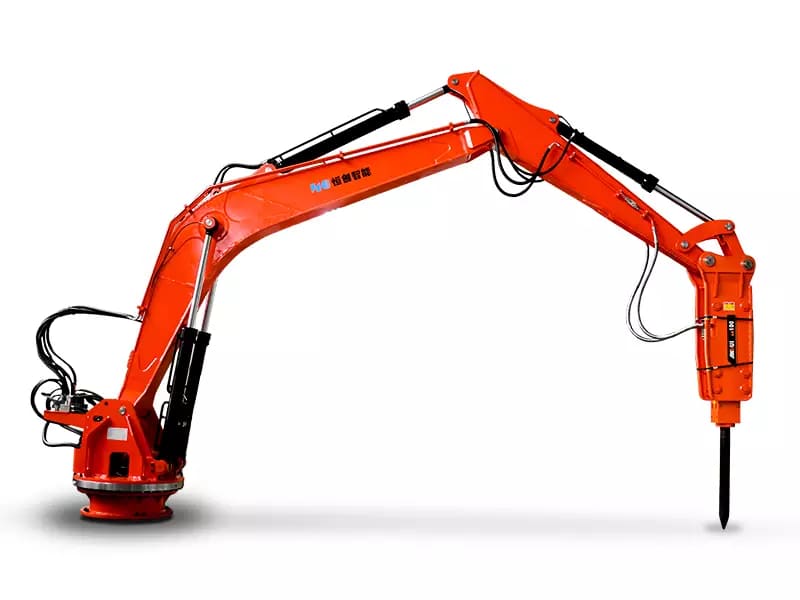
A rockbreaker boom system is a stationary, pedestal-mounted boom with a hydraulic hammer (or other tool) designed specifically to clear blockages and reduce oversize at fixed crushing and screening points. The boom provides controlled reach into the crusher mouth, feeder, or hopper, while the hammer fractures material that bridges, arches, or wedges.
In quarry settings, the biggest advantage of a rockbreaker boom system is availability: it’s always in position, ready to work. Because it’s engineered around the geometry of the crusher opening and the material flow path, it can often clear hang-ups faster and more consistently than mobile equipment.
Typical installations include:
Primary jaw or gyratory crusher feed opening
Dump pocket and grizzly area
Secondary and tertiary crushers where oversize appears
Transfer chutes where plugging occurs
An excavator-mounted hydraulic breaker is a versatile tool, commonly used for bench scaling, boulder breaking, trenching, demolition, and occasional crusher support. If the quarry already owns an excavator, adding a breaker can appear cheaper than installing a stationary boom. It can also serve multiple tasks across the site.
However, when an excavator is used to clear crusher blockages frequently, it becomes part of your “critical path.” That has major implications for safety and uptime—especially if the excavator must drive into constrained areas around the crusher station.
Safety is where the difference often becomes clearest, especially in busy quarries with tight layouts and multiple trucks cycling near the plant.
A rockbreaker boom system is typically operated from a protected cabin or remote station with clear visibility, and it’s engineered to work within a defined envelope. That reduces the chance of operators positioning themselves in the “line of fire” near the crusher throat.
An excavator-mounted breaker often requires driving into areas with limited clearance, poor sight lines, and proximity to edge drop-offs, retaining walls, or dump pockets. The operator may be closer to hazardous pinch points, falling rock, and rebound.
When a crusher blocks, the plant becomes a high-risk zone: bridging rock can release suddenly, oversize can tumble, and vibrations can destabilize material. A rockbreaker boom system is installed for this exact scenario, so you avoid improvised access routes and repeated traffic into the station.
With an excavator, you’re adding:
More mobile traffic near the plant
More reversing and maneuvering in tight spaces
Potential interactions with haul trucks and loaders
Operators sometimes resort to bars, chains, or manual clearing when a mobile breaker isn’t immediately available. A dedicated rockbreaker boom system can reduce the likelihood that crews attempt risky manual clearing because the tool is always on station.
Bottom line on safety: In most quarries, a rockbreaker boom system lowers exposure by keeping blockage-clearing controlled, repeatable, and within engineered boundaries—rather than relying on ad hoc mobile access.
In crushing circuits, minutes add up. A single blockage event can cause a cascade of losses:
Dump trucks waiting → cycle time increases → cost per ton increases
Screens and conveyors starved → throughput drops
Operators shift to “recovery mode” instead of stable production
A rockbreaker boom system is ready immediately. The operator can engage the blockage within seconds, often without pausing other coordinated tasks.
An excavator-mounted breaker must be:
Available (not assigned elsewhere)
Driven to the station
Positioned safely
Stabilized before breaking begins
That mobilization time becomes the hidden tax of the “cheaper” option.
Crusher mouths and dump pockets are awkward: steep angles, fixed steelwork, and constrained approach paths. A well-designed rockbreaker boom system is selected for reach, slew range, and hammer positioning in those tight geometries.
Excavators can struggle with:
Limited reach without putting the machine in a risky location
Difficult angles that reduce hammer efficiency
Repositioning time as the obstruction shifts
A stationary rockbreaker boom system creates a repeatable operating procedure: same position, same controls, same envelope, same workflow. That consistency improves clearing speed and reduces operator-to-operator variability.
With excavators, results often vary depending on:
Operator skill
Machine condition and breaker wear
Site congestion and access constraints
Bottom line on productivity: If blockages happen weekly—or daily—the uptime advantage of a dedicated rockbreaker boom system often outweighs the flexibility of an excavator-mounted breaker.
Quarry buyers often compare only purchase price: “A boom system costs more than a breaker attachment.” But total cost is a combination of CapEx, OpEx, downtime cost, and opportunity cost.
Rockbreaker boom system: Higher upfront cost due to pedestal mount, hydraulic power unit (or integration), boom structure, controls, and installation.
Excavator breaker: Lower incremental cost if you already own an excavator, but higher if you must purchase a dedicated carrier machine.
Both options have wear parts: tool bits, bushings, seals, hydraulic hoses, and hammer maintenance. But a rockbreaker boom system is typically used in a fixed application with more controlled operating angles—often reducing abusive side loading and unintended impacts.
Excavators in tight crusher zones can face:
Increased undercarriage wear from repeated travel
Higher risk of accidental contact with steelwork
More frequent hose damage from sharp edges and cramped positioning
The true cost driver is often production loss during unplanned stoppages. If your plant is rated at, say, 300–800 tons/hour, even short stoppages translate into significant lost revenue or higher unit costs. A rockbreaker boom system reduces stoppage duration by cutting mobilization time and improving clearing efficiency.
If blockages are rare (e.g., a few times per year), the economics tilt more toward a breaker attachment. If blockages are frequent, the stationary system often wins decisively.
Even if the excavator is “already owned,” using it as a blockage-clearing tool means it’s not performing other value-generating tasks:
Face work and scaling
Feeding mobile crushers
Stockpile management
Loading support and cleanup
A rockbreaker boom system frees mobile equipment to do what only mobile equipment can do.
Bottom line on total cost: In quarries with frequent blockages or high plant utilization targets, the total cost advantage often shifts to the rockbreaker boom system because it protects throughput and reduces disruption across the operation.
There are legitimate scenarios where an excavator breaker is the smarter tool:
Low blockage frequency: If your feed is well-scaled and bridging is rare.
Multiple work areas: You need the breaker for bench work, oversize at different locations, or demolition tasks.
Temporary plants: Short-term projects where permanent installation doesn’t make sense.
Space constraints: The crusher station cannot physically accommodate a pedestal boom structure.
In these cases, the excavator breaker delivers flexibility and can be financially sensible—especially if your operational rhythm doesn’t depend on instant blockage response.
A rockbreaker boom system tends to be the best choice when:
Blockages are frequent or unpredictable
Plant uptime is your top KPI
Crusher station access is tight or hazardous
Multiple trucks depend on continuous dumping
You want standardized, shift-to-shift clearing procedures
You need faster return to steady-state throughput
In other words: when the crusher is the heartbeat of your quarry, a dedicated rockbreaker boom system acts like an insurance policy against the most common causes of production interruption.
If you’re evaluating solutions, focus on measurable operational variables:
How often do blockages occur? (per shift, per day, per week)
What is your average clearance time now? (including mobilization)
What is the hourly cost of lost throughput? (tons/hour × margin or cost/ton)
Can the crusher station be accessed safely by an excavator under all conditions?
Is the excavator needed elsewhere during peak production?
Do you want a dedicated operator procedure that reduces variability?
If your answers trend toward frequent events, high throughput cost, and constrained access, it’s hard to beat a rockbreaker boom system.
Both systems have a role in modern quarry operations. An excavator-mounted breaker can be an excellent multi-purpose tool, especially when blockages are infrequent and site tasks are diverse. But for quarries where crusher stoppages are a regular threat to tonnage and scheduling, a dedicated rockbreaker boom system usually delivers the best mix of safety control, faster clearance, and lower total cost over time.
In practice, the most productive quarries often use both: a rockbreaker boom system guarding the primary station, and excavator breakers handling field breaking and occasional secondary support. The key is matching the tool to the risk profile and cost structure of your operation.
No. While primary crushers are common installations, a rockbreaker boom system is also widely used at secondary and tertiary crushers, transfer chutes, hoppers, and grizzlies—anywhere bridging, plugging, or oversize disrupts flow.
It can, but it often increases downtime due to mobilization and positioning time, and it can introduce additional safety exposure near the crusher station. In high-throughput environments with frequent blockages, a rockbreaker boom system typically provides faster, more consistent clearance.
The biggest ROI lever is usually reduced downtime—shorter and fewer stoppages at the crusher station. Secondary benefits include improved safety control, standardized operating procedures, and freeing excavators for other production tasks.