A rockbreaker boom system is built to keep crushers, grizzlies, hoppers, chutes, and bins flowing by breaking oversize rock and clearing blockages. In harsh operating environments—sub-zero winters, abrasive dust, and continuous duty cycles—maintenance becomes the difference between steady production and costly downtime. This guide explains how to maintain a rockbreaker boom system for cold weather performance, dust protection, and long-term hydraulic reliability, with practical checklists you can apply on-site.
Harsh sites add failure modes that don’t show up in mild climates:
Cold weather thickens hydraulic oil, slows response, increases pressure spikes, and makes seals less compliant.
Dust and fines abrade pins and bushings, contaminate lubricants, clog coolers, and accelerate wear on cylinders and breaker tools.
Hydraulic reliability is challenged by heat cycling, contamination, cavitation, improper pressure settings, and vibration-induced loosening.
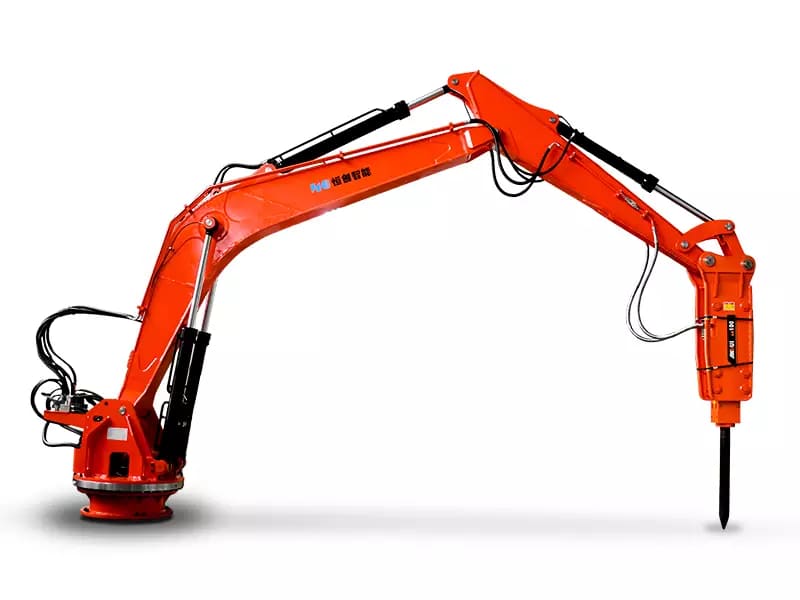
A rockbreaker boom system is a combination of structural, hydraulic, and control elements: boom, stick, slewing mechanism, base/column, hydraulic power unit (HPU) or plant hydraulics interface, valves, hoses, cylinder groups, breaker, and electrical/automation (where applicable). Maintenance must address all of these, not just the breaker tool.
Cold viscosity is a top cause of sluggish movements and pump stress. For a rockbreaker boom system operating in winter conditions:
Use a hydraulic oil grade approved by the equipment manufacturer for your expected temperature range.
If your site sees big swings (e.g., -20°C nights and warmer days), consider oils with high viscosity index that remain stable across temperatures.
Watch for foaming and aeration: cold starts can trap air, leading to erratic motion and cavitation damage.
Best practice: treat “oil selection” and “oil cleanliness” as a single system. Cold starts + dirty oil is a multiplier for valve sticking and seal wear.
A rockbreaker boom system should not be asked to deliver full force immediately in freezing temperatures.
Start the hydraulic power unit and run at low load until oil reaches a safe operating temperature.
Cycle cylinders slowly: small movements help circulate fluid and warm components evenly.
Avoid high-impact breaking until the breaker and hydraulic circuits are warm enough to prevent brittle seal behavior and pressure spikes.
Operator note: cold oil can trigger relief valve chatter. If you hear unusual noise or see surging, stop and let the system stabilize.
In cold conditions, elastomer seals harden and micro-leaks become visible.
Inspect cylinder rods for pitting, corrosion, or scoring—these damage seals quickly.
Check fittings and hose ends after the first hour of operation; temperature changes can cause contraction and loosen connections.
Keep rod surfaces clean; ice, grit, and salt can act like sandpaper on wipers.
Rule of thumb: small winter leaks often become summer failures because they indicate seal or surface damage that will worsen under higher cycle rates.
If your rockbreaker boom system uses sensors, limit switches, remote control, or automation:
Confirm cable jackets are rated for low temperatures and remain flexible.
Protect enclosures from condensation; cold-to-warm transitions can cause moisture to form inside boxes.
Verify emergency stop circuits and interlocks in cold starts—stiff buttons and moisture can create intermittent faults.
Dust is not just a housekeeping issue. It is a wear accelerator and a hydraulic reliability threat.
Even modest improvements in dust control can extend component life:
Improve sealing and skirting around hoppers/chutes to reduce dust clouds near the boom base.
Use targeted water misting or dust suppression (site rules permitting) to reduce airborne fines.
Avoid directing dust-laden airflow across the hydraulic cooler or electrical enclosures.
A clogged cooler raises oil temperature, which accelerates oxidation and reduces hydraulic reliability.
Clean cooler fins routinely using low-pressure air from the “clean side” outward to avoid embedding dust.
Inspect for oil film on cooler fins—this traps dust and indicates a leak.
Monitor oil temperature trends; a steady rise over weeks often indicates cooler restriction or bypass valve issues.
Dust + inadequate lubrication is a classic wear combination.
Use the correct grease type recommended for heavy-duty, dusty applications.
Grease at the right frequency—often more frequently in dusty sites.
Wipe grease points clean before applying grease to avoid injecting grit into bearings.
Pay special attention to:
Boom and stick pins
Slew ring/bearing and gear teeth
Breaker mounting bracket pins and bushings
Practical tip: track pin wear by measuring play at defined intervals (e.g., monthly). If play increases faster than expected, increase lubrication frequency and check for damaged seals or misalignment.
Dust sticks to oily surfaces. If rod surfaces become “gritty,” wipers will be overwhelmed.
Keep cylinder rods clean; consider protective guards or boots where feasible (but ensure they don’t trap abrasive fines).
Review hose routing and clamping: vibration can cause hoses to rub, creating weak spots that fail under pressure.
Replace worn clamps and abrasion sleeves early—hose failures are often preventable.
Hydraulic issues can hide until production demands peak. A rockbreaker boom system that “seems fine” can still be eating itself internally if contamination and pressures aren’t controlled.
Hydraulic oil contamination causes valve sticking, pump wear, cylinder scoring, and breaker performance loss.
A strong program includes:
Filtration discipline: use quality return and pressure filtration, and maintain breathers (desiccant breathers help in humid/cold climates).
Sampling and analysis: periodic oil analysis for particle count, water content, and wear metals.
Correct topping-up practices: use filtered transfer containers; never open-fill from dirty drums.
Water control: water can enter via condensation, damaged seals, or washdown. Water reduces lubricity and promotes corrosion.
If you only choose one metric to track, choose particle contamination trend plus water content. These correlate strongly with reliability.
Improper pressure settings can destroy a rockbreaker boom system over time.
Confirm system relief pressures match the manufacturer’s specifications for the boom and breaker.
Verify breaker supply flow is correct; excessive flow can overheat oil and accelerate seal wear.
Watch for pressure spikes during cold starts or when the breaker hits solid resistance.
Maintenance action: schedule periodic checks of relief valve settings and look for drift. Vibration and wear can change settings over long intervals.
Cavitation can occur if the pump starves for oil or if the oil is too viscous during cold starts.
Symptoms include:
rattling or unusual pump noise
sluggish or inconsistent cylinder movement
foamy oil in sight glass
overheating with no obvious load increase
Fixes include proper warm-up, correct oil viscosity, suction line inspection, and ensuring reservoir levels and baffles are correct.
The breaker itself is a critical part of the rockbreaker boom system maintenance plan.
Inspect tool wear: chisel/moil/point tools wear faster in abrasive rock.
Maintain correct tool lubrication (where applicable) and check retainer pins.
Verify the breaker is not being used as a prying tool; side loading can damage the tool, bushings, and boom structure.
Monitor accumulator charge (if applicable) per manufacturer instructions—wrong charge affects impact energy and can stress the hydraulic circuit.
Harsh conditions often mean higher vibration, more shock loads, and more thermal cycling.
Re-torque critical fasteners on a schedule (e.g., after installation, after the first week, then monthly/quarterly depending on duty).
Use appropriate locking methods: mechanical locking, correct thread treatments, and proper washer selection.
Conduct routine visual inspections on high-stress areas: boom/stick junctions, base pedestal, slew ring mounts, and breaker brackets.
Look for paint cracking, rust lines, or “dust tracing” along welds—these can signal a crack.
If cracks appear, stop operation and repair properly; “keep running” often turns small cracks into structural failure.
Slew bearing and gear issues can cause misalignment, unusual noise, and accelerated wear.
Check backlash and lubrication.
Inspect slew drive mounting and gear tooth condition.
Listen for rhythmic knocking during rotation—often a warning sign.
Below are practical intervals you can adapt to your actual duty cycle.
Walk-around: leaks, loose hoses, damaged guards
Check oil level and visible contamination (cloudiness/foam)
Clean cylinder rods and inspect for scoring
Quick check of cooler airflow path and dust buildup
Verify breaker tool retention and obvious damage
Thorough grease service of pins, bushings, and slew gear/bearing
Inspect hose clamps, abrasion sleeves, and routing
Clean cooler fins more deeply (site dust levels determine frequency)
Check fasteners on breaker mount and high-vibration areas
Oil sampling and analysis (more frequent in extreme conditions)
Check relief pressure settings and breaker flow
Inspect slew bearing condition and gear wear
Measure pin play and bushing wear trends
Inspect structural welds on boom, pedestal, and brackets
Confirm correct oil grade for expected temperatures
Verify breathers, seals, and reservoir condition for condensation control
Review operator warm-up procedures and retrain if needed
Stock critical spares: hoses, seal kits, filters, tool retainers, and breaker tools
Skipping warm-up and going straight to heavy breaking in sub-zero temperatures.
Over-greasing without cleaning grease points first (injecting dust into bearings).
Ignoring cooler clogging until overheating appears (damage already started).
Running with minor leaks (often a sign of rod damage or seal failure).
Using incorrect hydraulic oil for the season or mixing oil types.
Treating filtration as optional—contamination control is non-negotiable for hydraulic reliability.
Allowing side loads on the breaker tool, which can damage the entire rockbreaker boom system.
Use an approved cold-weather hydraulic oil, follow a structured warm-up routine (circulate oil and slowly cycle cylinders), and inspect seals/hoses early in the shift for contraction-related loosening. Avoid full breaker duty until oil temperature stabilizes, then ramp up gradually.
Dust enters through breathers, open fill practices, worn wipers, and contaminated grease points. Once inside, it increases particle count, causes valve sticking, accelerates pump wear, and scores cylinders. Strong filtration, clean filling methods, and disciplined greasing are the fastest ways to prevent this.
Focus on contamination control (filters, breathers, clean oil handling), cooler cleaning to prevent overheating, pin/bushing lubrication and wear tracking, hose routing/abrasion protection, and periodic checks of pressure/flow settings. These actions address the root causes of most failures in harsh environments.