Crusher blockages are not “random events” in mines and quarries—they are a predictable outcome of oversize rock, slabby fragmentation, wet sticky fines, and imperfect feed presentation at the primary crushing bottleneck. When the pocket bridges or the crusher mouth chokes, the entire circuit can stall: trucks queue, conveyors starve, and operators are forced into high-risk interventions. A rockbreaker boom system is designed to prevent those stoppages from becoming extended downtime by breaking oversize and restoring flow quickly and repeatably.
This article explains how a rockbreaker boom system reduces blockages and downtime, how to size and install a rockbreaker boom system, and how to operate and maintain a rockbreaker boom system in real mine and quarry conditions. Along the way, you’ll also see how the terms stationary rock breaker and rock breaker system relate to the same equipment category.
Most jams come from three recurring patterns:
Single-piece wedging: one hard, oversized boulder lodges across the jaw or at the gyratory dump pocket.
Bridging/arching: flat or slabby rock forms a stable arch at a grizzly, chute, or bin, starving the crusher until it collapses.
Sticky build-up: wet clay-like fines create hang-ups and “rat-holing,” especially in transfer chutes and pockets.
A rockbreaker boom system treats the symptom fast (clear the hang-up), but the best teams also use the rockbreaker boom system as feedback: which blast patterns are generating oversize, where bridging forms, and which pocket geometry is encouraging hang-ups. Over time, that feedback helps reduce the frequency of interventions, not just the duration.
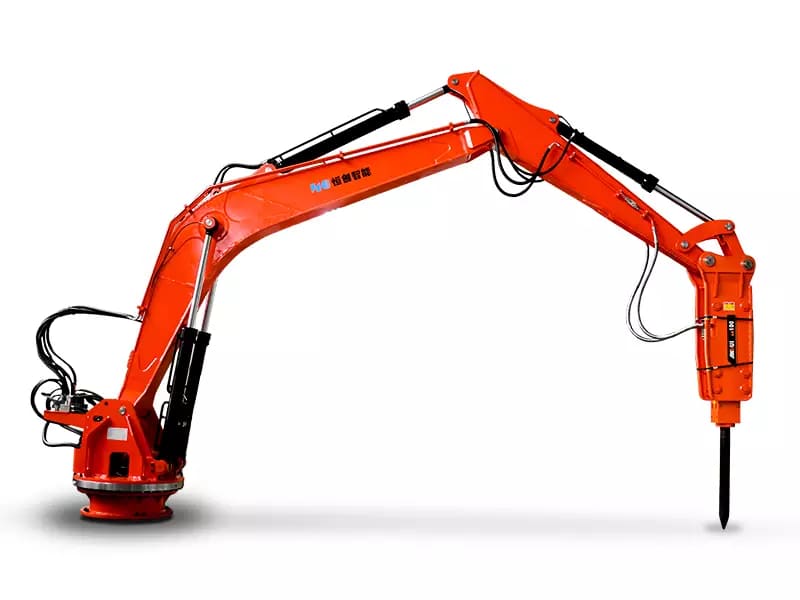
A rockbreaker boom system is a hydraulically actuated boom (multi-section arm) carrying a hydraulic hammer, mounted on a pedestal or structural steel near the blockage zone—typically at a primary crusher mouth, grizzly/scalper, chute, ore pass, or hopper. The boom provides reach and positioning; the breaker provides impact energy; the controls keep the operator away from the danger zone. Many suppliers and buyers refer to the same concept as a stationary rock breaker, and rock breaker system is often used as a category term covering similar engineered packages integrated into crushing plants.
Crucially, a rockbreaker boom system is not “just a breaker.” It is an engineered package: boom + pedestal + power/hydraulics + controls + guarding, often with cameras and plant interlocks. In other words, a rockbreaker boom system is a process tool for the bottleneck, not a one-off emergency accessory.
The immediate win from a rockbreaker boom system is shorter stoppages. Instead of waiting for a loader to maneuver, or forcing manual clearing, the rockbreaker boom system can quickly attack the oversize piece or arch from the correct angle. The purpose is explicitly framed by multiple application sources as fast, safe releasing of clogged primary crushers and grizzly oversize.
Blockage clearing is hazardous because it involves suspended loads, sudden releases, and pinch points. Quarry safety discussions emphasize that breaker booms reduce the risk associated with jaw crusher blockages by enabling remote, controlled intervention. A rockbreaker boom system does not remove all hazards, but it significantly reduces exposure compared with manual clearing.
A rockbreaker boom system can be used for more than hammering—raking and presenting rock into the crusher can stabilize drawdown and reduce surging. Some boom suppliers explicitly describe using mid-range systems to feed material into the crusher and rake the hopper area to improve productivity. With more stable feed, overload events and stop-start cycles become less frequent, which can reduce wear spikes.
Downtime at the primary crusher is expensive because it blocks the critical path. Even a simple illustrative example shows the scale: one industry article estimates that if a plant produces 500 tons/hour with a $10/ton profit margin, one hour of downtime is roughly $5,000 in lost profit (and an 8-hour shift stoppage about $40,000). Your numbers will differ, but the direction is consistent: as throughput and fixed costs rise, a rockbreaker boom system pays back faster.
A rockbreaker boom system is typically installed at:
Primary jaw crusher mouth (covering hopper corners)
Gyratory dump pocket
Grizzly/scalper bars (breaking oversize on the grate)
Ore pass or chute hang-up points
Surge bins and hoppers where bridging repeats
These locations match common rock breaker system application descriptions that list primary crushers, grizzlies, ore-pass sites, and stationary crushing plants.
Selection is a matching problem: geometry + material + duty + controls.
Under-reaching is the #1 sizing failure. Your rockbreaker boom system must reach the farthest mouth/grizzly point and both corners without unstable angles. Many boom brochures stress the basic requirement: the boom enables the breaker to reach into the mouth of the crusher, reduce oversize, and clear hopper blockages. In practice, map the 3D “blockage envelope” and verify the working range.
If the site is dominated by single hard boulders, the rockbreaker boom system needs sufficient impact energy. If bridging dominates, the rockbreaker boom system needs precise control and enough energy to “cut” the arch without collapsing the pocket unpredictably. For wet sticky hang-ups, the rockbreaker boom system must rake and break locally, not simply smash.
A rockbreaker boom system transmits shock into steel and concrete. Foundation design, anchor patterns, and fatigue life matter—especially for retrofits into existing dump pockets. Treat the rockbreaker boom system as dynamic equipment, not static steelwork.
At minimum, your rockbreaker boom system needs operator-safe control with clear line-of-sight or cameras. Some rock breaker system packages include joystick control and plant integration options (starter panels, interlocks, automation packages) that standardize operation and reduce “operator variability.” In Russia/Central Asia conditions, also prioritize cold-weather operability, sealed electrics, and serviceability.
A rockbreaker boom system delivers the best ROI when it is used early and routinely—not only during major jams.
Intervene early: Use the rockbreaker boom system at the first sign of bridging or power draw instability, before a full shutdown.
Rake before you hammer: Many problems are solved by using the rockbreaker boom system to present rock into the crusher and clear corners.
Avoid “hitting steel”: Define no-go zones (liners, chute walls, feeder steel) so the rockbreaker boom system doesn’t create its own repair work.
Standardize camera views: In dark pockets, the rockbreaker boom system is only as effective as visibility.
A rockbreaker boom system works in shock, vibration, dust, and temperature extremes—exactly where maintenance discipline matters.
Shift checks for a rockbreaker boom system:
Pins/retainers and boom structure visual check
Greasing (boom joints, breaker tool)
Hose chafe, fittings, and leaks
Abnormal vibration/noise
Weekly/monthly checks for a rockbreaker boom system:
Pedestal bolts, structural weld inspections
Bushing wear and pin clearance checks
Breaker tool wear and retainer condition
Filtration and oil cleanliness monitoring
In harsh climates, add warm-up routines and oil/filtration choices appropriate to low temperatures and contamination levels. A rockbreaker boom system is “reliable” when wear items are predictable and failures are rare.
Buying a rockbreaker boom system for breaker energy alone while ignoring reach and corner access
Installing a rockbreaker boom system where the real hang-up zone is out of envelope
Treating the stationary rock breaker as occasional emergency equipment instead of routine process control
Skipping cameras/lighting and then blaming the rockbreaker boom system for slow clearing
Using rock breaker system as a loose label without verifying the full engineered package (guards, controls, interlocks)
If your mine or quarry loses hours to bridging, oversize wedging, or sticky hang-ups at the primary crushing bottleneck, a rockbreaker boom system is one of the most direct ways to cut downtime and reduce risk. A properly specified rockbreaker boom system—correct reach envelope, correct breaker class, engineered pedestal, and operator-safe controls—turns a dangerous, improvisational task into a repeatable process. Operate the rockbreaker boom system early, rake as much as you hammer, and maintain the rockbreaker boom system with disciplined checks so it stays a solution, not a new failure point.
1) Is “stationary rock breaker” the same as a rockbreaker boom system?
In most mine and quarry contexts, yes. “stationary rock breaker” emphasizes the fixed installation, while rockbreaker boom system often refers to the full engineered package (boom + pedestal + breaker + hydraulics + controls).
2) Where should a rockbreaker boom system be installed for the biggest impact?
Typically at the primary crusher mouth or the grizzly/scalper where bridging and oversize repeatedly stop flow. The best location is where the boom can reach the full blockage envelope safely and consistently.
3) What does “rock breaker system” mean compared with rockbreaker boom system?
rock breaker system is often used as a category term for breaker-boom packages integrated into crushing plants (mobile, portable, or stationary). In practical buying decisions, confirm that the rockbreaker boom system includes the complete package: boom, pedestal, power, controls, guarding, and visibility aids.