Underground mines and tight quarry installations have a very specific pain profile: restricted headroom, narrow access routes, poor visibility, and high consequences when material flow stops. A single hang-up in a chute, grizzly, ore pass collar, or surge bin can starve the plant, idle trucks, and force hazardous manual intervention. In these environments, a rockbreaker boom system isn’t a “nice-to-have”—it’s a control tool for keeping tonnes moving safely. The challenge is that underground and tight sites demand a compact, purpose-built rockbreaker boom system, not a scaled-down surface design.
This article explains how to design and select a rockbreaker boom system for underground and constrained layouts, including compact reach envelopes, mounting strategies, controls, and maintenance practices. You’ll also see where the terms stationary rock breaker and rock breaker system fit into procurement and specification language.
In tight sites, blockage frequency increases because:
Fragmentation variability is amplified: Oversize rocks have fewer places to “go,” so they wedge at the first restriction point.
Geometry is less forgiving: Shorter chutes, sharper transitions, and small pocket volumes encourage bridging and arching.
Moisture and fines build-up: Underground humidity plus fines can create sticky hang-ups and ratholes.
Access is limited: When something jams, the response options are fewer—and often riskier.
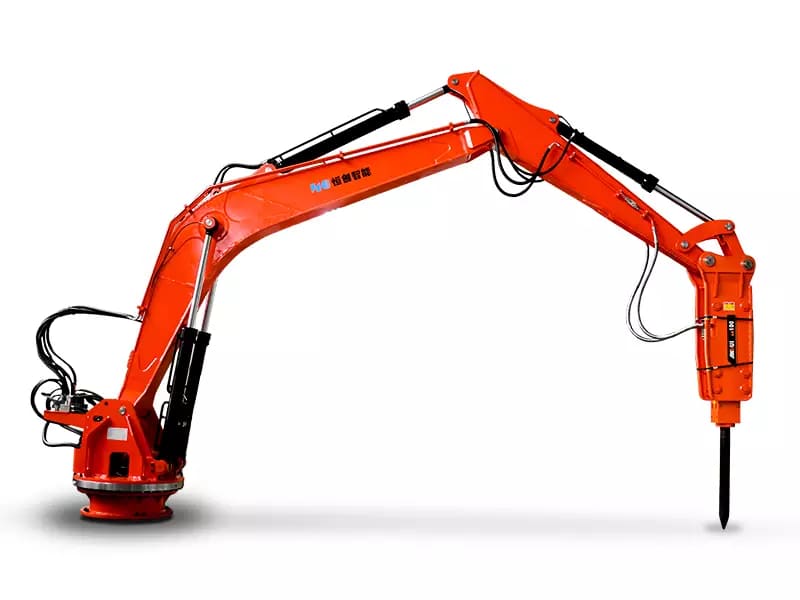
A compact rockbreaker boom system solves the practical problem: clear hang-ups quickly, keep people away from the drop zone, and prevent stoppages from becoming extended downtime. In procurement language, many teams describe the same category as a stationary rock breaker (emphasizing fixed installation), while rock breaker system is commonly used as a broader umbrella term for engineered breaker-and-boom packages.
For underground applications, “compact” does not simply mean shorter boom segments. A compact rockbreaker boom system must balance four constraints:
Reach coverage: The rockbreaker boom system must still reach the entire “hang-up envelope”—the locations where bridging actually occurs, not just where it is easy to reach.
Working angles: The rockbreaker boom system must operate without extreme joint angles that reduce hammer effectiveness and accelerate wear.
Installation footprint: The rockbreaker boom system must fit around existing steel, liners, chutes, guarding, and walkway clearances.
Serviceability: The rockbreaker boom system must allow tool changes, greasing, and hose replacement in a cramped maintenance window.
If any one of these is neglected, the rockbreaker boom system becomes either under-reaching (can’t clear the real jam) or over-constrained (too hard to operate and maintain).
A rockbreaker boom system in underground and tight sites most commonly supports three areas:
Chutes jam when slabby rock bridges at a transition, when fines cake on walls, or when a single oversized piece rotates and wedges. A rockbreaker boom system here needs short, precise movements and a mount that avoids collision with chute steel. In tight sites, the rockbreaker boom system is often used as much for “raking and presenting” material as for hammering.
Grizzlies are designed to reject oversize, so hang-ups are expected. A compact rockbreaker boom system must reach the grizzly face, corners, and the immediate area where oversize builds. If the rockbreaker boom system can’t address the corners, those corners will become chronic hang-up zones.
Bins and pockets create bridging because the cross-section narrows. A rockbreaker boom system needs enough reach to break arches safely without striking liners, feeders, or structural steel. In tight sites, the rockbreaker boom system must also work with limited sight lines, making camera placement and lighting critical.
Sizing a rockbreaker boom system underground is primarily a geometry exercise, then an energy exercise.
Map where the hang-ups happen: chute transitions, ore pass lips, grizzly corners, bin shoulders. A rockbreaker boom system must cover those points with adequate tool angle. Don’t design around “where you can mount it easily.” Design around where the jam occurs.
In tight sites, collision risk is real. Your rockbreaker boom system should be validated against:
Guard rails, handrails, walkways
Chute lips and liner edges
Cable trays and pipes
Feeder housings and grizzly supports
A compact rockbreaker boom system often benefits from a slightly elevated mount and a carefully chosen swing radius, so the boom can “enter” the work zone while the base stays clear.
The breaker on the rockbreaker boom system must be strong enough for your hardest oversize, but controllable enough for bridging. In many underground cases, you want a breaker class that clears quickly without violent shock loading that damages liners. A rockbreaker boom system that is oversized in impact but under-designed in foundation can create structural problems.
A rockbreaker boom system is dynamic equipment. Tight sites often mean thinner steel members, retrofit anchors, and short load paths—so fatigue and resonance matter. A rockbreaker boom system pedestal must be engineered for repeated hammer loads and raking forces, with realistic duty assumptions.
When floor space is limited, a side mount can keep the rockbreaker boom system out of traffic paths. The key is ensuring the mounting structure can handle torsion from the boom swing. In tight sites, a rockbreaker boom system that “fits” but flexes is a future failure.
An elevated mount can improve reach into bins and grizzlies while protecting equipment from spillage. A rockbreaker boom system mounted from above must still allow maintenance access—especially tool changes and hose service.
Some tight-site designs intentionally limit swing to prevent collisions. A rockbreaker boom system with restricted swing can be safer and simpler, provided the restricted arc still covers the full hang-up envelope.
Visibility is often the limiting factor, not the boom’s strength. A rockbreaker boom system underground should be designed as an operator system:
Cameras: At least one primary camera with protected mounting; ideally a secondary angle to remove blind spots.
Lighting: Industrial lighting aimed at the work zone; dust and mist can destroy visibility without it.
Control station placement: The operator should run the rockbreaker boom system from a safe, repeatable position with clear camera feeds and minimal distractions.
Interlocks and procedures: The rockbreaker boom system should be integrated into a lockout approach that prevents unintended feeder/crusher start during clearing.
In bid specs, you can reference the package as a rock breaker system to make sure vendors include controls, guarding, and visibility—not just the boom and hammer. If your site calls it a stationary rock breaker, that’s fine, but the expectation should remain: the rockbreaker boom system is a complete engineered installation.
A rockbreaker boom system is most effective when used proactively and consistently:
Rake first, hammer second
Use the rockbreaker boom system to reposition rock and collapse unstable arches gently before heavy impact.
Target the key contact point
For bridging, strike the “keystone” area rather than randomly hammering. A rockbreaker boom system is a precision tool when the operator is trained.
Avoid steel strikes
Set clear “no-hit” zones and train operators to keep the rockbreaker boom system tool away from liners, feeder pans, and chute lips.
Standardize clearing sequences
Build a short SOP: when to stop feed, when to use the rockbreaker boom system, when to resume, and how to confirm clear flow.
Underground conditions—dust, humidity, temperature swings—punish hydraulics and joints. Keep the rockbreaker boom system reliable by focusing on high-frequency basics:
Daily: grease points, visual hose inspection, tool condition, loose fasteners.
Weekly: check pin play, bushing wear indicators, pedestal bolt torque checks, camera lens cleaning.
Monthly/Quarterly: hydraulic filtration, oil cleanliness checks, structure inspection for cracks, alignment checks.
A compact rockbreaker boom system must be maintainable in place. If servicing requires dismantling half a platform, the rockbreaker boom system will not get maintained—and reliability will drop.
When writing an RFQ, ensure the rockbreaker boom system scope includes:
Boom and breaker matched to duty
Engineered pedestal and foundation design loads
Controls (local/remote), camera(s), and lighting
Guarding, collision avoidance considerations, hose routing protections
Commissioning, operator training, and spare parts list
This is where using the term rock breaker system can help: it signals you want an integrated package. Meanwhile, stationary rock breaker can be used as a synonym, but keep “system completeness” explicit. Ultimately, your goal is a rockbreaker boom system that clears hang-ups fast and survives the duty cycle.
Underground and tight-site material handling doesn’t tolerate improvisation. The right rockbreaker boom system provides controlled reach, safe clearing, and repeatable uptime improvements at chutes, grizzlies, and bins—where blockages would otherwise become recurring downtime and safety exposure. The best results come from treating the rockbreaker boom system as an engineered installation: correct reach envelope, robust mounting, strong visibility, disciplined operating practices, and practical maintenance access. Whether your procurement team calls it a stationary rock breaker or a rock breaker system, the success criteria are the same: the rockbreaker boom system must fit the geometry, match the material, and keep tonnes moving without putting people in harm’s way.
1) Is a stationary rock breaker different from a rockbreaker boom system?
In most mining and quarry contexts, stationary rock breaker is a naming preference for the same equipment category. The term rockbreaker boom system often emphasizes the full package—boom, breaker, pedestal, hydraulics, controls, and safety/visibility components.
2) How do I choose a rockbreaker boom system for a tight chute or bin?
Start with geometry: map the hang-up envelope and verify the rockbreaker boom system can reach all critical points with safe working angles. Then match breaker class to the hardest oversize you expect, and ensure the mounting structure is engineered for dynamic loads.
3) What should be included when a vendor offers a rock breaker system?
At minimum, a complete rockbreaker boom system offer should include the boom and breaker, engineered pedestal/foundation loads, controls, and practical visibility aids (cameras/lighting), plus guarding and commissioning/training so the system is safe and operable in real conditions.