Tunnel construction often focuses on the main bore, but many of the most demanding tasks happen in smaller underground sections such as cross passages and safety niches. These areas are narrow, difficult to access, and often unsafe for large machines or close-range manual work. That is why the demolition robot is becoming an increasingly practical solution for modern tunneling projects.
A demolition robot can combine compact size, remote control, and high attachment versatility in a way that fits the real needs of these confined underground zones. For contractors dealing with tight turning radii, limited headroom, and frequent repositioning, choosing the right demolition robot can improve both safety and efficiency.
A cross passage is a connecting tunnel built between two parallel tunnels or between a main tunnel and another underground section. In rail, metro, and road tunnel projects, cross passages are often used for emergency escape, ventilation, maintenance access, drainage routing, or service connections.
Compared with the main tunnel, a cross passage is usually much narrower and shorter. Construction conditions are more restrictive because the work area is squeezed between structural boundaries and often close to finished or partially finished tunnel surfaces. Equipment used here must be able to enter limited spaces, operate without excessive setup, and perform precise excavation or demolition without damaging surrounding rock support or lining.
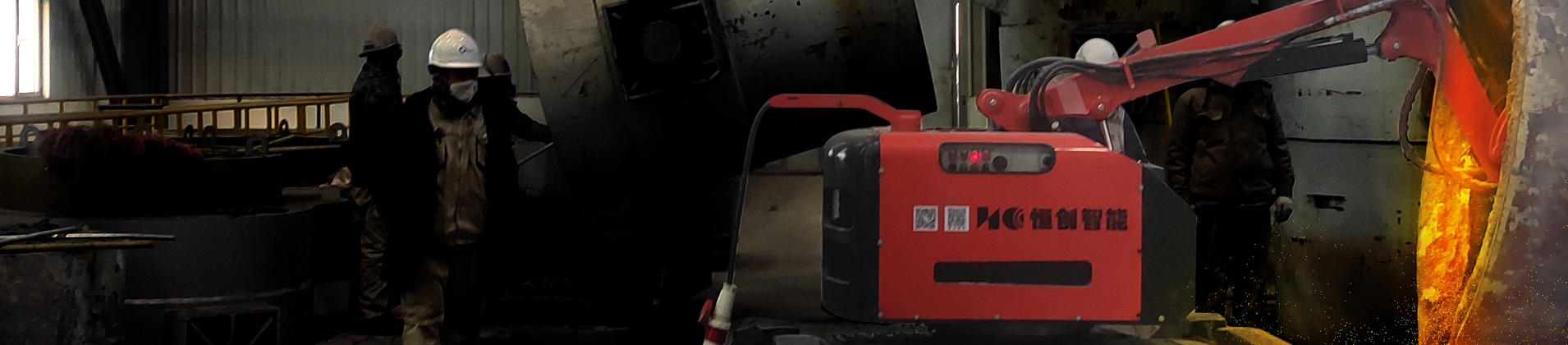
This is where a demolition robot for cross passages becomes highly valuable. It can enter spaces that are difficult for larger excavators, yet still provide enough power for controlled rock breaking, surface trimming, and localized removal work.
A safety niche is a recessed area built into the sidewall of a tunnel to provide temporary refuge for workers, maintenance personnel, or emergency use. In some tunnel designs, safety niches may also support equipment storage, cable routing access, or operational safety requirements.
Although a safety niche is smaller than a cross passage, it can be even more difficult to construct. The available operating space is very limited, and the work often involves precise excavation, trimming, scaling, or lining preparation. In these conditions, standard tunnel machinery may be too large or too aggressive.
That is why robotic excavation for safety niches is gaining attention. A compact robotic machine can work close to the face or sidewall while keeping the operator at a safer distance. This improves control and reduces the need for workers to stand directly beneath unstable rock or freshly disturbed surfaces.
The main tunnel usually provides more room for machine movement, material handling, and equipment repositioning. Cross passages and safety niches do not. These smaller tunnel sections create several operational challenges:
A full-size excavator or breaker may physically struggle to enter or turn within a cross passage. In a safety niche, the problem is even greater. Low-profile and compact dimensions are essential.
Traditional equipment often needs more room to reposition than these areas can provide. A compact robot for cross passages can work effectively with minimal turning space and can often be moved more easily between work points.
Cross passages and niches frequently require localized excavation rather than bulk removal. Overbreaking can increase support costs, delay lining work, and create safety issues. Compact, remote-operated robotic tools are better suited for controlled trimming.
These areas expose workers to rockfall, dust, vibration, and unstable surfaces at close range. A demolition robot reduces the need for manual work directly at the face and supports safer tunnel niche construction equipment strategies.
Getting equipment into a narrow underground area is not only about machine size. Transport routes, staging zones, ventilation limits, and work sequencing all matter. Smaller robotic machines are generally easier to deliver, deploy, and relocate underground.
A demolition robot is not only a breaking machine. In tunneling, its value comes from its ability to handle multiple localized tasks with high control.
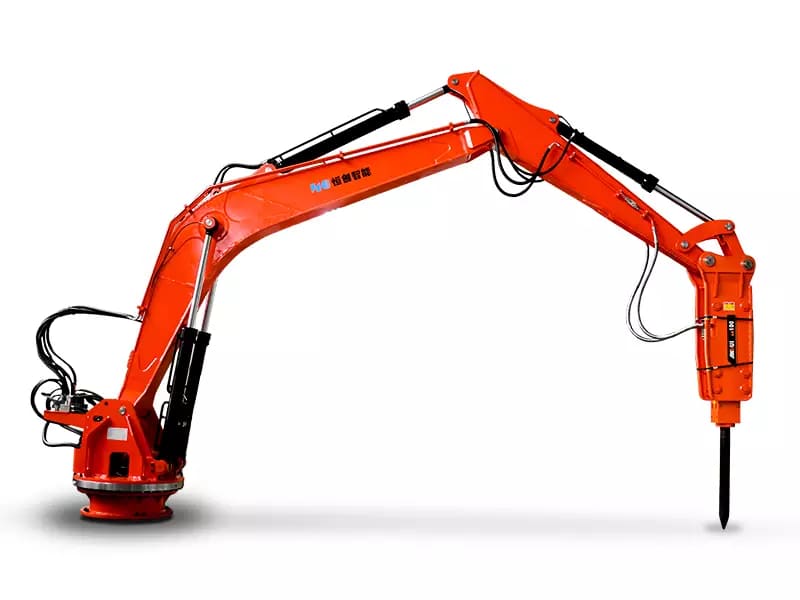
In cross passages and safety niches, excavation is often selective. Operators may need to remove hard rock in one area while protecting nearby support elements or prepared surfaces. A demolition robot can perform controlled excavation using hydraulic breakers or other attachments suited for confined operations.
Tunnel sections often require profile adjustment after the initial cut. Uneven rock surfaces, overhanging sections, and irregular edges must be trimmed before support installation or finishing work continues. Robotic systems allow operators to perform trimming more accurately than large bulk excavation machines.
There are also cases where partially completed tunnel structures, temporary supports, or misaligned sections must be removed and corrected. A demolition robot can handle this work with less disruption than conventional heavy equipment, especially in narrow side areas where access is poor.
Loose rock and unstable fragments can be removed more safely with a robotic unit than through manual scaling. In addition, robots can assist in preparing surfaces for shotcrete, reinforcement, or lining activities.
The following comparison shows why robotic equipment is often better suited for cross passages and safety niches than larger conventional machines.
| Factor | Large Conventional Equipment | Demolition Robot |
|---|---|---|
| Access in narrow sections | Often difficult | Strong suitability |
| Maneuverability | Limited in tight spaces | High |
| Precision for trimming | Moderate | High |
| Remote operation | Usually limited | Standard advantage |
| Operator safety | Lower in confined zones | Higher |
| Setup flexibility | Slower | Faster |
| Multi-attachment use | Depends on machine size | Common advantage |
A safety niche excavation robot is especially useful when the project requires a machine that can combine compact dimensions with controlled output. Instead of forcing oversized equipment into restricted zones, contractors can use a machine designed for tight underground geometry.
When evaluating tunnel cross passage equipment, contractors should focus on more than just impact force. The best demolition robot solution should also be assessed by:
machine width and transport dimensions
boom reach in confined spaces
attachment compatibility
power source suitability for underground use
stability on uneven tunnel floors
ease of relocation between small work zones
remote-control precision and operator visibility
For cross passages and safety niches, the best machine is not always the largest or most powerful. It is the one that can work safely, accurately, and repeatedly in a restricted environment.
Cross passages and safety niches are small parts of a tunnel project, but they create outsized construction challenges. Their confined geometry, limited access, and precision demands make conventional equipment less effective and often less safe. A demolition robot offers a more practical approach by combining compact size, maneuverability, remote operation, and versatile performance.
For contractors looking to improve underground productivity, reduce worker exposure, and handle detailed excavation or demolition in narrow sections, a demolition robot is one of the most effective solutions available. Whether the task involves a demolition robot for cross passages or robotic excavation for safety niches, the value lies in controlled performance in places where space is limited and safety matters most.
Learn more about tunnel-ready robotic equipment at: https://www.hcrot.com/
Not in every situation, but in narrow cross passages a demolition robot is often more practical for localized excavation, trimming, and demolition. It is especially useful where access and maneuverability are the main constraints.
Safety niches require precise work in very tight areas. A demolition robot allows remote-controlled excavation and trimming, reducing worker exposure while improving control in confined tunnel spaces.
They should focus on machine dimensions, turning ability, boom reach, attachment options, remote-control accuracy, and how easily the machine can be transported and repositioned underground.