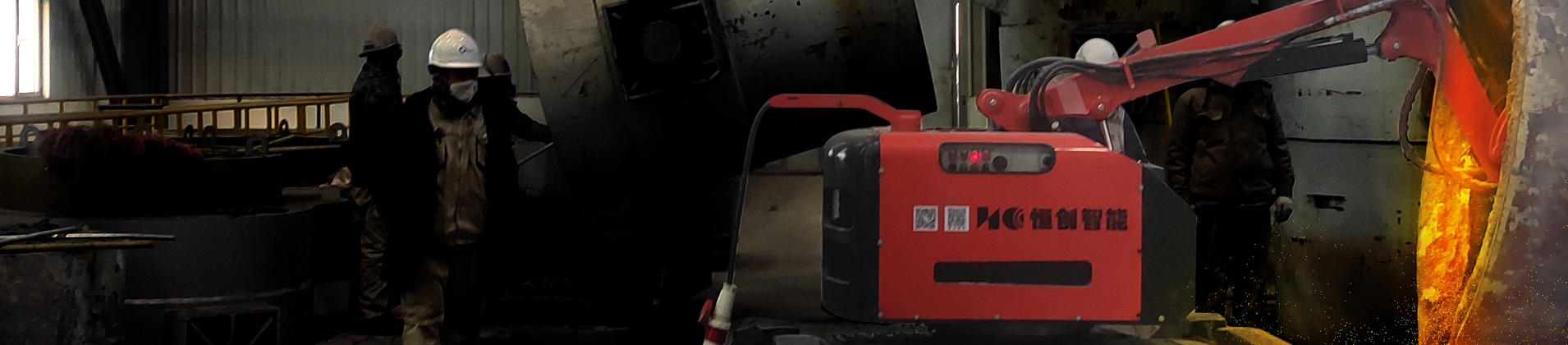
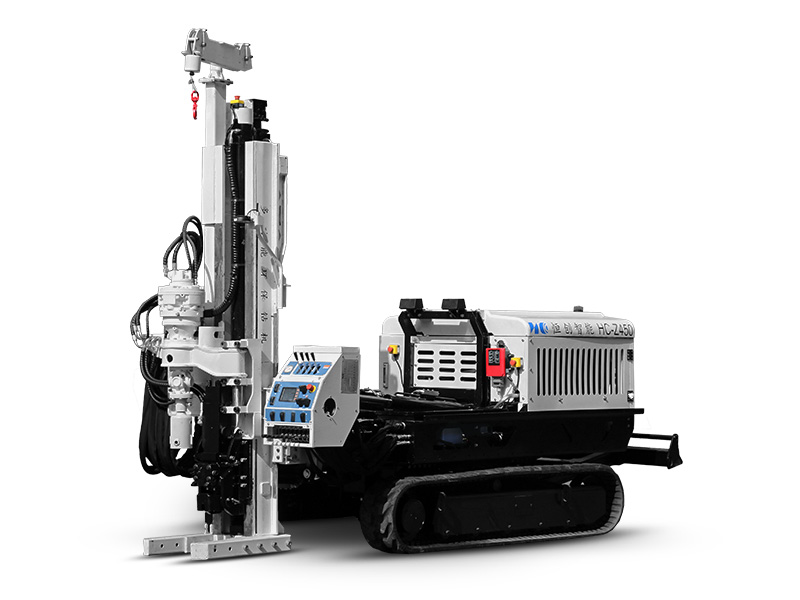
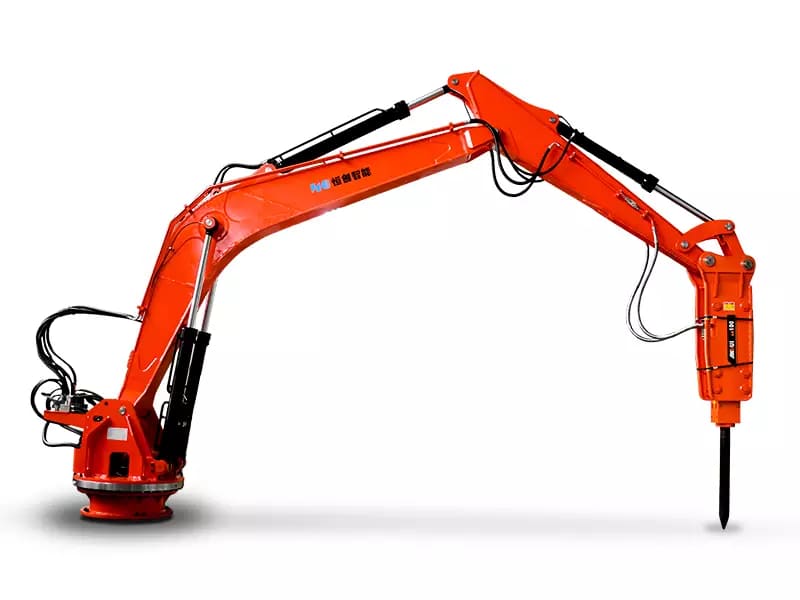
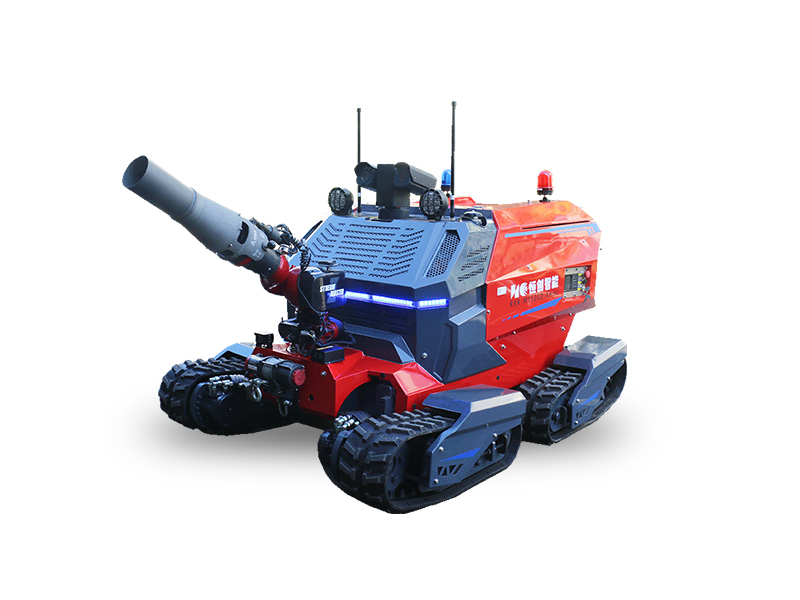
Underground tunnel projects often face one persistent challenge: limited working space. Whether the job involves railway tunnels, subway tunnels, connecting passages, utility tunnels, culverts, or underground service corridors, contractors must complete demolition, breaking, scaling, trimming, and maintenance work in areas where conventional machinery is difficult or impossible to operate. This is where a demolition robot becomes highly valuable.
A demolition robot combines compact dimensions, strong breaking power, remote operation, and multi-attachment flexibility, making it suitable for confined underground environments where safety, access, and efficiency are equally important.
Tunnel construction and maintenance rarely offer open, flexible working conditions. Space is usually restricted by the tunnel diameter, lining structure, ventilation pipes, cables, drainage systems, temporary supports, rails, conveyor systems, and other installed facilities.
In connecting passages and utility tunnels, the available width may be even more limited. Workers and machines often need to operate near walls, corners, slopes, shafts, or partially completed structures. In these conditions, equipment size directly affects whether the work can be completed efficiently.
Common space restrictions include:
| Underground Area | Space Challenge | Equipment Requirement |
|---|---|---|
| Railway tunnel | Rails, limited side clearance, long travel distance | Stable, compact tunneling equipment |
| Subway tunnel | Narrow access, strict safety control, urban restrictions | Low-emission or electric equipment |
| Connecting passage | Short but very narrow working face | Compact demolition robot |
| Utility tunnel | Pipes, cables, drainage systems | Precise confined space demolition equipment |
| Shaft or portal area | Difficult lifting and transportation | Small footprint and easy positioning |
A demolition robot for confined spaces is designed to work where excavators, loaders, and large breakers cannot easily enter or maneuver.
In underground projects, small equipment is not useful unless it can still deliver enough demolition power. This is one of the key reasons contractors choose a demolition robot. A compact demolition robot can pass through narrow access points while still carrying hydraulic breakers, crushers, buckets, drills, or other attachments.
This balance between size and force is important for several reasons.
First, tunnel access is often fixed. If equipment cannot pass through the portal, shaft, service entrance, or temporary opening, it cannot be used at all.
Second, the working face may be close to walls or curved tunnel linings. A tunnel robot for narrow spaces must be able to position its boom accurately without constantly repositioning the entire machine.
Third, underground demolition often involves hard concrete, rock, refractory material, or reinforced structures. Lightweight manual tools may not provide enough force, while large machines may be too bulky. A demolition robot fills this gap by offering high power density in a small body.
Remote control is another major advantage. Underground spaces often expose workers to dust, falling debris, vibration, noise, unstable surfaces, and poor visibility. In traditional demolition, operators may need to stand close to the breaking point, increasing safety risks.
With an underground demolition robot, the operator can control the machine from a safer distance, often with a better viewing angle. This reduces direct exposure while improving precision.
Remote-controlled operation is especially valuable in:
Scaling loose rock or concrete from tunnel walls
Removing damaged lining sections
Breaking concrete around shafts or connecting passages
Working near unstable structures
Operating in dusty or noisy underground areas
For project managers, this means safer work execution without relying only on manual labor or oversized equipment.
Choosing confined space demolition equipment is not only about machine power. Practical site conditions often determine whether the equipment can actually perform well.
In narrow tunnels, equipment may need to turn around, reverse, or reposition within limited clearance. A compact demolition robot with a small turning radius is easier to maneuver in curved tunnels, junctions, and connecting passages.
Underground equipment may need to be transported by crane, lift, rail trolley, forklift, trailer, or temporary platform. Smaller machines are easier to move between work zones and can reduce preparation time.
Access points may include portals, shafts, small service doors, temporary openings, or inclined ramps. Large machines may require dismantling, special lifting, or additional civil work. A compact demolition robot can often enter with less modification to the site.
Many tunnel projects are located in cities, mountains, mines, or remote infrastructure corridors. In urban subway and utility tunnel projects, equipment must often meet restrictions on exhaust, noise, and working hours. Electric-powered demolition robots can be especially useful in these scenarios because they reduce emissions underground.
Traditional excavators, loaders, and large hydraulic breakers are powerful, but they are not always suitable for underground tunnel spaces.
| Traditional Equipment Limitation | Impact in Underground Spaces |
|---|---|
| Large body size | Difficult to enter narrow tunnels or shafts |
| Large turning radius | Hard to reposition in connecting passages |
| Operator sits close to work area | Higher exposure to falling debris and dust |
| Exhaust emissions | Ventilation pressure in enclosed spaces |
| Limited precision in tight areas | Higher risk of damaging surrounding structures |
| Difficult transportation | More setup time and higher logistics cost |
In many tunnel projects, using oversized equipment can create secondary problems: longer setup time, more manual assistance, higher safety risk, and lower flexibility. A demolition robot offers a more practical alternative when the work area is narrow, sensitive, or difficult to access.
A demolition robot is not simply a smaller machine. It is designed for high-efficiency demolition in difficult spaces. Its value comes from the combination of compact design, hydraulic power, remote operation, and attachment compatibility.
For underground contractors, this can support:
Faster access to narrow work zones
Reduced manual demolition intensity
Safer operation away from hazardous areas
Better control near tunnel linings and existing structures
Flexible use across breaking, drilling, crushing, and material handling tasks
This makes the demolition robot for confined spaces a strong solution for tunnel maintenance, subway construction, mining passages, utility tunnels, and underground rehabilitation projects.
Yes. A compact demolition robot is designed for restricted access areas, including tunnels, shafts, connecting passages, and utility corridors. The exact suitability depends on tunnel width, access height, ground condition, and required attachment.
In many cases, yes. Manual demolition may be flexible, but it exposes workers to dust, falling debris, vibration, and fatigue. A remote-controlled demolition robot improves safety while delivering stronger and more consistent demolition force.
Key factors include machine width and height, working range, turning radius, power supply, attachment compatibility, transportation method, ventilation conditions, and whether the machine can safely reach the work face.
For tunnel contractors working in narrow, underground, or high-risk environments, choosing the right demolition robot can improve safety, reduce setup complexity, and increase overall jobsite efficiency. Learn more about compact robotic demolition solutions at https://www.hcrot.com/