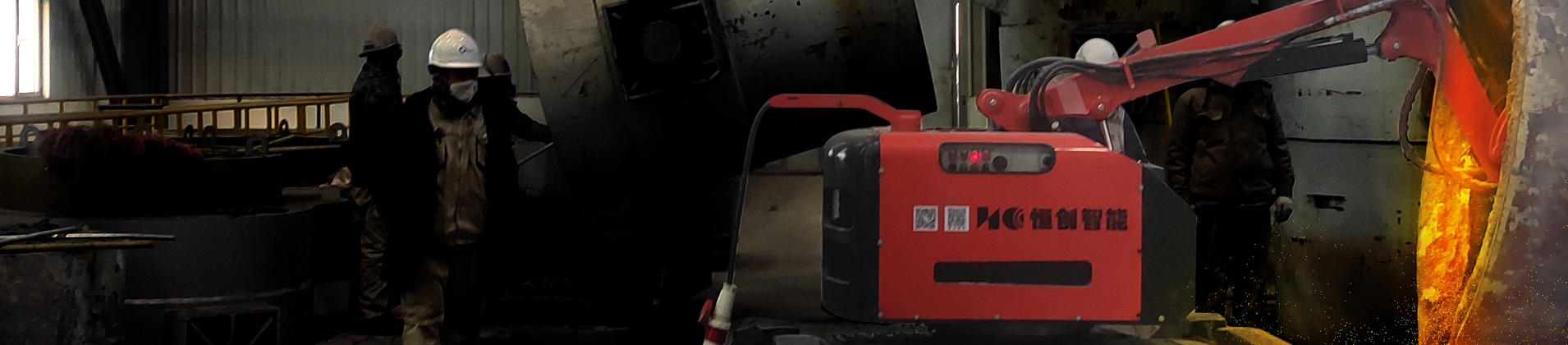
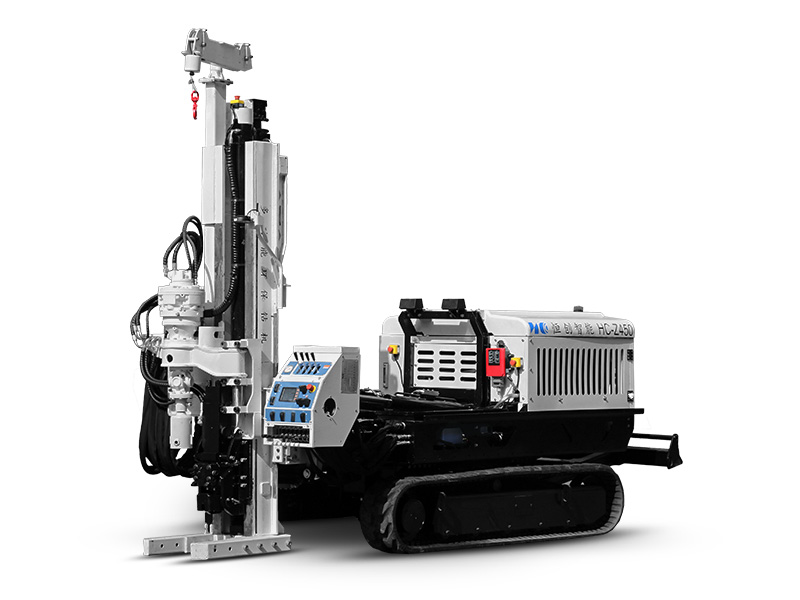
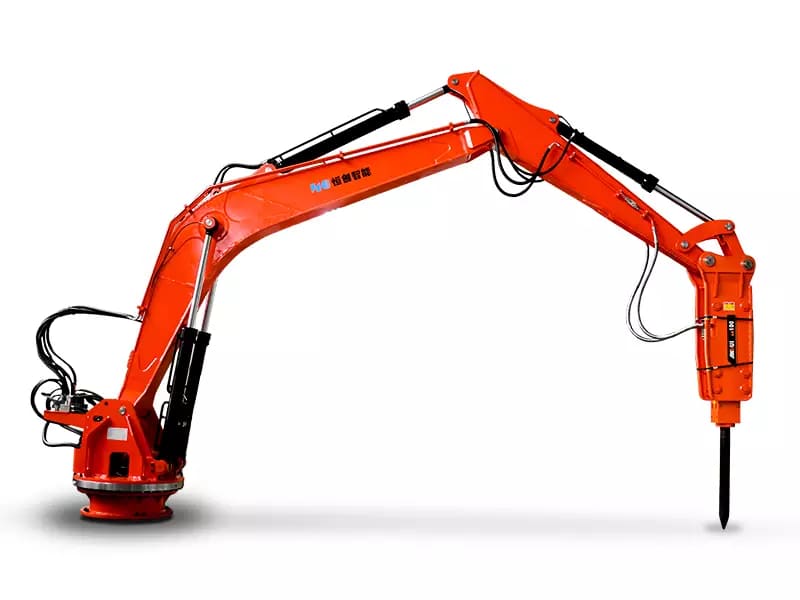
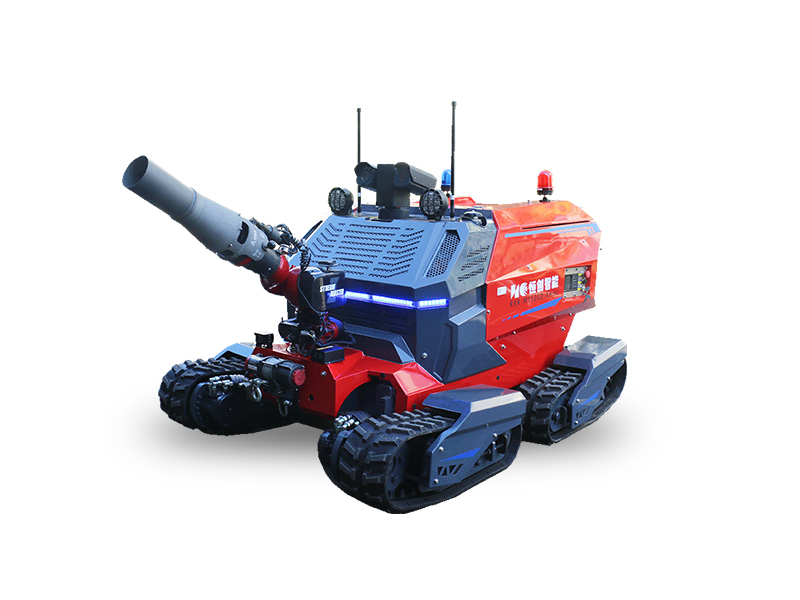
Underground mines demand productivity under constraints: narrow headings, limited ventilation, complex ground control, and high-consequence hazards around mobile equipment, drawpoints, and conveyor systems. In this environment, the demolition robot has shifted from “nice-to-have specialty machine” to a practical tool for safer, more consistent underground work. A demolition robot is essentially a compact, high-power carrier that uses interchangeable tools (breaker, bucket, grapple, scaler, cutter, etc.) and is designed to work where people and conventional machines face the highest risk or the lowest efficiency.
This guide explains how to use a demolition robot in underground mining operations, with a focus on real workflows: planning, deployment, task execution, and maintenance. You’ll also see where robotic demolition and a remote controlled demolition robot deliver the strongest return—especially for precise cleaning under conveyors, scaling loose rock, secondary breaking, and re-entry work after blasts or rockfalls.
A demolition robot matches underground mining because it concentrates capability into a small footprint. Underground success is often a geometry problem: you need reach, precision, and tool force—without bringing in oversized equipment or placing people in hazardous zones. The remote controlled demolition robot approach supports three underground priorities:
Standoff safety: operators work outside the immediate hazard envelope.
Precision power: controlled tool force reduces collateral damage to services, supports, chutes, and infrastructure.
Multi-tool flexibility: one demolition robot can cover multiple “nuisance-but-critical” tasks that otherwise consume downtime and manpower.
When implemented correctly, robotic demolition becomes a standard operating practice, not an exception.
Underground belt systems are production arteries—and frequent problem areas for spillage, fines buildup, and housekeeping issues. A demolition robot can remove compacted material under or near conveyors with controlled movements, reducing the need for personnel to work in proximity to pinch points and moving components. For mines that rely on continuous conveying, a remote controlled demolition robot enables repeatable cleanup cycles with less exposure and more predictable duration.
Where the demolition robot is most effective:
Under-belt spillage removal (return belt areas, skirtboard zones)
Chute mouth clearing and buildup removal
Transfer-point floor cleanup without bringing in bulky equipment
Removing hardened fines that require breaking before shoveling
This is one of the fastest ROI applications for a demolition robot because it directly reduces nuisance stoppages and cleanup time.
Scaling is a constant requirement underground: backs and walls can shed rock after blasting, during re-entry, and as conditions evolve. A demolition robot can carry scaling tools or breakers to remove loose rock without placing people directly under questionable ground. In many headings, a remote controlled demolition robot is a safer way to perform selective scaling in awkward geometry where access is limited.
Oversize boulders at ore passes, grizzlies, or crusher inlets can bottleneck production and create dangerous manual interventions. A demolition robot with a breaker can reduce oversize in a controlled way. The advantage of robotic demolition here is precision: you can break the rock without damaging liners, grizzlies, chutes, or adjacent services.
Older workings and re-mined veins can contain collapsed support, fallen pipes, and damaged services. A demolition robot is useful for controlled removal of debris, selective breaking of unstable material, and careful handling of obstacles before crews re-enter for repairs.
Some underground tasks are simply not worth direct human exposure—areas with poor ground, limited egress, high dust, or potential for secondary collapse. A remote controlled demolition robot provides a practical “first-in” capability: clear debris, test stability, and prepare the zone before human entry.
Before the demolition robot moves, define:
The task scope (cleanup volume, scaling area, oversize size range)
The success condition (clean floor, open chute, scaled face)
A “do-not-damage” list (cables, ventilation ducting, sensors, hydraulic lines, supports, belt structure)
This is where robotic demolition differs from brute-force work: the goal is controlled removal with minimal collateral impact.
Underground deployment requires logistics:
Route planning (turning radii, gradients, crosscuts)
Traffic control (LHDs, trucks, personnel)
Ground control review (backs condition, support status, re-entry timing)
A remote controlled demolition robot is safer, but it’s not magic—your plan still needs controls for ground stability, isolation procedures where applicable, and clear exclusion zones.
A single demolition robot can become inefficient if the tool selection is wrong. For underground mining, typical tool sets include:
Breaker for compacted fines, oversize, and hard buildup
Bucket/scraper for pull-back and cleanup
Grapple for debris handling
Scaling tool or breaker-based scaling for backs and walls
Define a sequence like break → rake/pull → collect/handle → finish pass. This makes the demolition robot predictable and repeatable shift to shift.
The best practice for a remote controlled demolition robot is to run it from a safe standoff with strong visibility:
Keep line-of-sight where possible
Use lighting/cameras if the zone is dark or occluded
Ensure the operator has a safe retreat path and is not positioned under questionable ground
Precision is the differentiator. If visibility is poor, the demolition robot will be slower and more likely to cause incidental damage.
In underground mining, controlled technique is everything:
Use small tool bites and incremental removal near services
Avoid high-energy swings around supports and belt structures
Break compacted buildup before attempting to push or drag it
Keep the tool aligned to minimize side loads and ricochet
The more refined the technique, the more your demolition robot behaves like a surgical instrument rather than a wrecking device.
After each job:
Inspect the work area for collateral damage risk
Document cycle time and tools used
Record what made the job fast or slow (visibility, access, material type)
Standardize the work instruction for future repeats
This is how robotic demolition becomes an operational system.
Goal: remove spillage and buildup without damaging belt infrastructure.
Best practices:
Keep the demolition robot movements low and controlled near belt structures
Break hardened fines before pulling them out
Maintain a consistent “work face” so debris moves away from hazards
Finish with a precision pass around cable trays, guards, sensors, and skirting
A remote controlled demolition robot is particularly effective here because the operator can stand outside the conveyor corridor’s highest-risk zones while still performing accurate work.
Goal: remove loose rock from backs and walls safely.
Best practices:
Start with a scan-and-test approach (small contacts, observe response)
Work from supported ground toward the face where possible
Keep the demolition robot positioned to avoid undercutting unstable slabs
Use controlled force, not maximum power by default
Scaling is where the demolition robot often pays for itself in risk reduction.
Goal: reduce oversize without damaging chute or crusher infrastructure.
Best practices:
Stabilize the rock before breaking (avoid rolling/falling)
Break at natural planes and edges to reduce tool energy
Keep the breaker aligned; avoid sideways prying
Clear fragments with a bucket/grapple rather than repeated hammering
A well-run demolition robot reduces oversize faster and with fewer “hands-on” interventions.
To succeed underground, a demolition robot must be matched to the mine’s constraints:
Compact geometry and mobility
The demolition robot must fit your headings, corners, and ramps.
Tool ecosystem and quick-change capability
Underground productivity improves when the demolition robot can switch tools quickly between breaking, cleaning, and handling.
Fine control for infrastructure protection
The best remote controlled demolition robot setups allow micro-movements and smooth actuation for work near services and supports.
Durability in abrasive, wet, dusty conditions
Mines punish equipment. Choose a demolition robot designed for harsh environments and straightforward maintenance.
Service model and spare strategy
Uptime matters. Treat the demolition robot as a critical asset with planned maintenance, consumables management, and operator training.
A demolition robot delivers the most value when it’s not “borrowed occasionally,” but scheduled like a real production resource. Successful mines often implement:
A dispatch model: assign the demolition robot to recurring tasks (transfer points, oversize hotspots, routine scaling areas)
Shift-level KPIs: cycle time, downtime avoided, exposure hours reduced, repeat-cleanup interval
Operator certification: standardized techniques for conveyor cleanup, scaling, and secondary breaking
Job libraries: pre-written methods for common tasks, making robotic demolition consistent
This is how a demolition robot becomes part of the mine’s operating rhythm.
Using a demolition robot underground is not only about adding a machine—it’s about upgrading the way mines handle the riskiest, most interruption-prone tasks. A well-deployed demolition robot improves precision cleaning under conveyors, safer scaling, faster secondary breaking, and more controlled rehabilitation work. When you standardize methods, train operators, and treat it as a scheduled asset, robotic demolition becomes a repeatable system that supports both safety and throughput. If you want to explore product options, underground mining case applications, and configuration ideas for a remote controlled demolition robot, you can review more details directly on the company website: https://www.hcrot.com/
Conveyor-area spillage cleanup and transfer-point buildup removal are often the fastest ROI because they reduce frequent nuisance stoppages and minimize human exposure near conveyor hazards. A demolition robot can standardize these tasks into predictable cycles.
In many headings, a remote controlled demolition robot can reduce or eliminate the need for manual scaling in higher-risk zones, especially after blasting or where ground conditions are uncertain. It’s most effective when paired with clear scaling procedures and trained operators.
Treat infrastructure protection as a design constraint: define a “do-not-damage” list, enforce precision-first technique, maintain good visibility, use incremental removal near services, and select the right tool for each phase. With the right operating model, robotic demolition becomes controlled, not chaotic.