Choosing the right demolition robot for tunnel work is not just about buying a compact machine with enough power. Tunnel conditions vary widely between railway, subway, and road projects, and the wrong equipment choice can reduce productivity, increase downtime, and create safety issues. A practical tunnel robot selection guide should evaluate tunnel type, machine size, boom reach, power source, attachment options, and the need for multi-functionality.
This article explains how to choose demolition robot for tunnel projects with a focus on railway tunnel demolition robot applications, subway tunnel demolition equipment requirements, and road tunnel construction robot selection.
Before comparing models, contractors should understand that tunnel design and construction methods directly affect demolition robot selection.
Railway tunnels usually involve long linear work zones, strict schedule pressure, and limited possession windows. In rehabilitation or enlargement projects, access time may be short, so fast deployment and quick site changeover are critical. A railway tunnel demolition robot often needs solid rock breaking capacity, good reach, and reliable operation over long shifts.
Subway tunnel demolition equipment usually works in tighter spaces with stricter ventilation, dust, noise, and vibration control. Urban projects also tend to have more logistical constraints, including narrow shafts, transport limitations, and limited staging areas. In these jobs, a smaller demolition robot with strong maneuverability and electric or low-emission power options is often more suitable.
A road tunnel construction robot is often used in wider tunnel sections, portal zones, maintenance shutdowns, and lining removal work. These projects may require a balance between reach, versatility, and output. Because road tunnels often involve different work fronts, site mobility and attachment change speed become important.
The best demolition robot for tunneling is rarely the biggest machine. It is the machine that matches the tunnel geometry, material strength, and work cycle.
Start with access constraints. Check:
tunnel width and height
shaft or portal transport limitations
turning radius in narrow headings
ability to move across uneven ground or temporary work platforms
A machine that is too large may offer more power but become inefficient if it cannot enter certain sections or requires time-consuming relocation support.
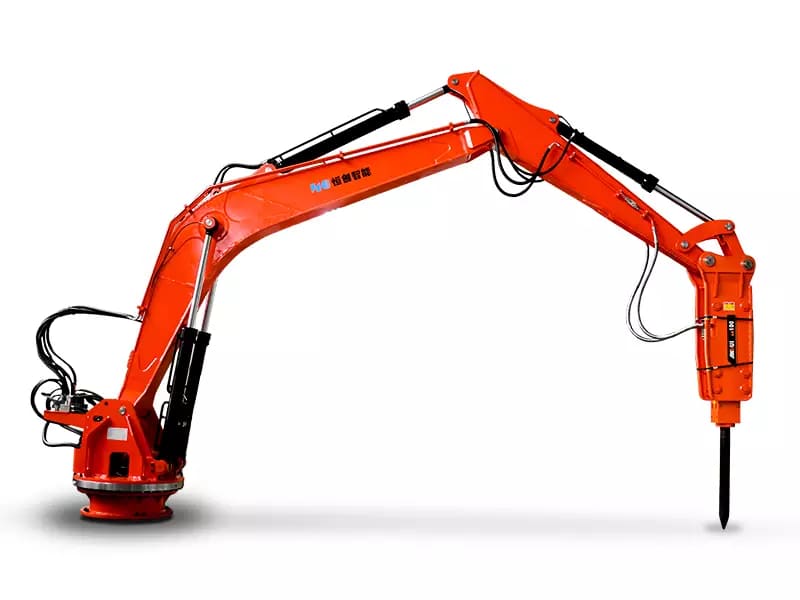
Boom length affects more than reach. It determines whether the robot can safely work on tunnel crowns, sidewalls, invert areas, and difficult corners without repeated repositioning.
For example:
short to medium boom: better for tight subway tunnel demolition equipment use
medium to long boom: useful for railway tunnel demolition robot tasks where reach to the crown and sidewall matters
longer boom with stable chassis: often preferred in larger road tunnel construction robot scenarios
The working envelope should match actual tunnel geometry, not just maximum advertised reach.
Tunnel demolition often involves hard rock, reinforced concrete, old lining removal, and scaling loose material. That means hydraulic output and breaker performance matter.
Evaluate:
breaker impact energy
hydraulic flow and pressure
continuous operating stability
cooling capacity for long shifts
If the application includes only light concrete trimming, extreme power may be unnecessary. If the job includes rock breaking or heavy lining removal, underpowered equipment will quickly become a bottleneck.
A demolition robot becomes more valuable when it can support multiple attachments efficiently. Common tunnel attachments include:
hydraulic breakers
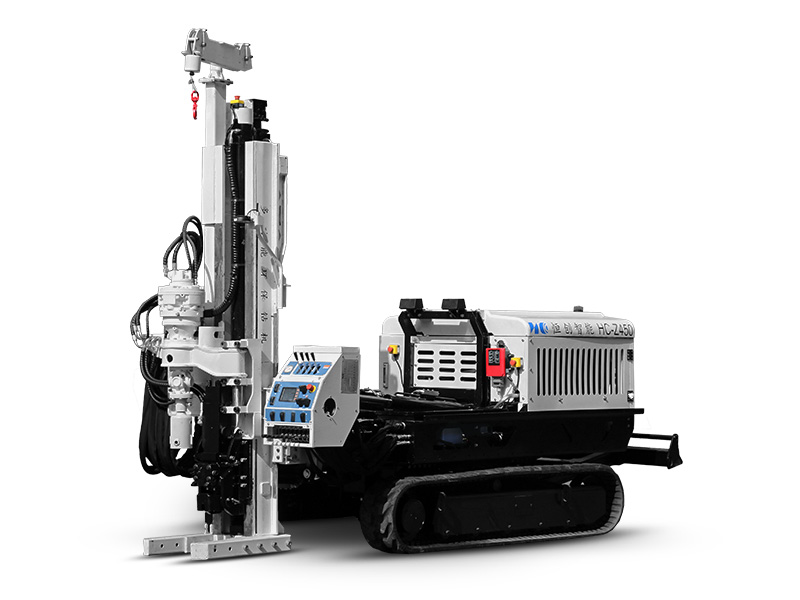
rock drills
scaling tools
shotcrete preparation tools
buckets or mucking accessories
crushers or shears for reinforced sections
A good tunnel robot selection guide always asks whether the carrier can switch tools quickly and whether the hydraulic system truly supports those tools at productive levels.
Power supply is a major decision in tunnel projects.
| Selection factor | Electric power | Diesel/hybrid power |
|---|---|---|
| Ventilation demand | Lower | Higher |
| Urban subway suitability | Better | More restricted |
| Long remote sections | Depends on cable layout | Often easier |
| Emissions control | Strong advantage | Weaker |
| Mobility flexibility | Cable management required | Higher mobility |
In subway and enclosed urban work, electric demolition robot solutions are often attractive because they reduce ventilation burden. In remote or frequently moving sites, diesel or hybrid options may still offer operational advantages.
Many buyers focus only on demolition, but tunnel projects often involve several adjacent tasks. That is why contractors increasingly ask whether they need drilling, shotcrete support, and rock breaking in one platform.
A multi-function demolition robot is valuable when:
the site has frequent task changes
one contractor handles several tunnel processes
space is too limited for multiple dedicated machines
possession windows are short and equipment count must be minimized
In these cases, using one carrier for drilling, scaling, rock breaking, or preparation work can improve utilization and reduce equipment congestion.
If the project consists mainly of one repetitive heavy-duty task, such as continuous lining demolition or rock breaking, a specialized machine with optimized attachment performance may be more productive and easier to maintain.
So the answer is not always “more functions are better.” The right choice depends on utilization rate, attachment change frequency, and crew skill.
A low-price machine may become expensive if it creates downtime, requires frequent maintenance, or slows site turnover.
Consider the full cost in four parts:
Initial machine price and attachment package.
Energy consumption, wear parts, tool steel, cable management, and labor.
Access to spare parts, service response time, local technical support, and ease of routine servicing.
In tunnel projects, site changeover speed has real value. A robot that is easy to transport, quick to set up, and fast to switch attachments can save many productive hours over a project lifecycle.
| Project type | Typical priority | Recommended focus |
|---|---|---|
| Railway tunnel | Reach, productivity, fast possession-window work | Strong breaker performance, medium-long boom, reliable long-shift operation |
| Subway tunnel | Compact size, low emissions, maneuverability | Smaller footprint, electric option, easy transport, low ventilation burden |
| Road tunnel | Versatility, mobility, balanced output | Medium-large machine, flexible attachments, efficient site changeover |
To choose demolition robot for tunnel projects effectively, start with the tunnel environment rather than the catalog. A railway tunnel demolition robot should prioritize reach, output, and fast work cycles. Subway tunnel demolition equipment should prioritize compact dimensions, maneuverability, and controlled emissions. A road tunnel construction robot often needs the best balance of versatility and productivity.
The best demolition robot for tunneling is the one that matches tunnel size, required attachments, power supply conditions, and the real pace of site changeover. A strong tunnel robot selection guide should always compare not only demolition force, but also multi-function potential, maintenance practicality, and life-cycle cost.
The most important factor is the actual tunnel environment, including space limits, ventilation, access route, and material hardness. Machine size and reach should be matched to the tunnel profile before considering extra features.
In many cases, yes. Electric models can reduce emissions and ventilation demand, which is especially useful in enclosed urban subway environments. However, cable management and site power availability must also be considered.
If your tunnel project involves frequent switching between rock breaking, drilling, and related tasks, one multi-function machine can improve efficiency and reduce congestion. If the work is highly repetitive and focused on one task, a specialized machine may deliver better output.
For more tunnel demolition robot solutions and application support, visit: https://www.hcrot.com/