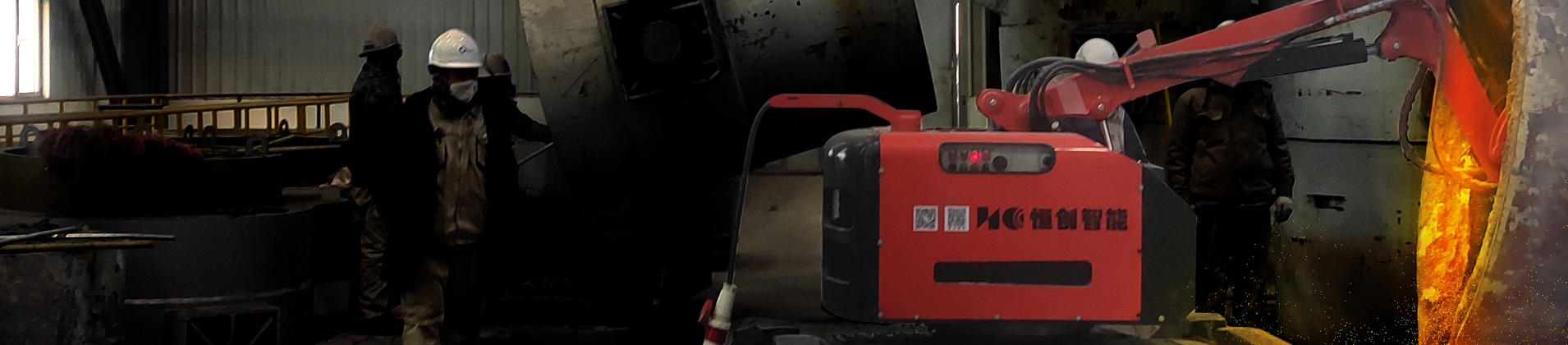
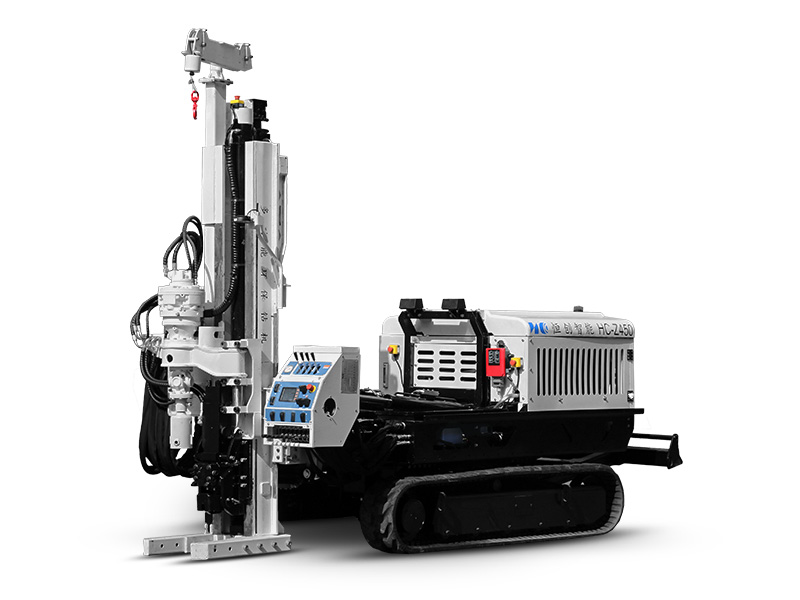
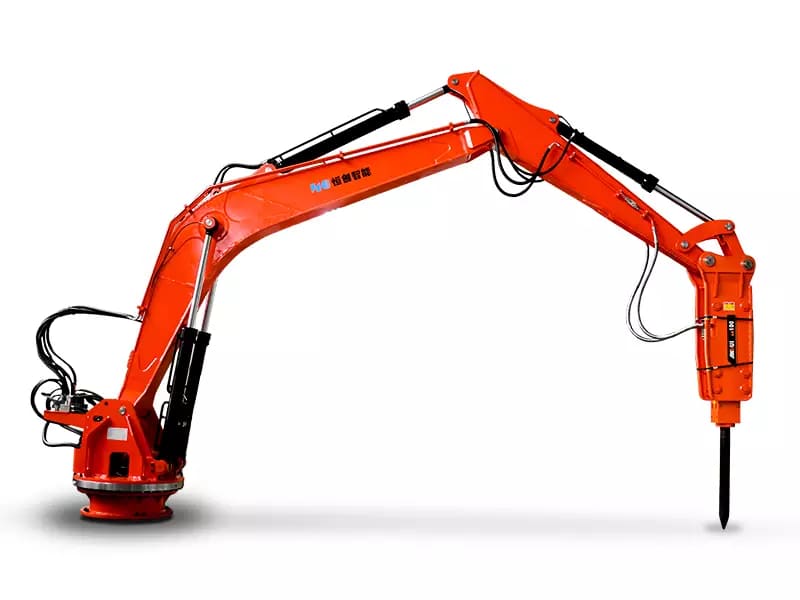
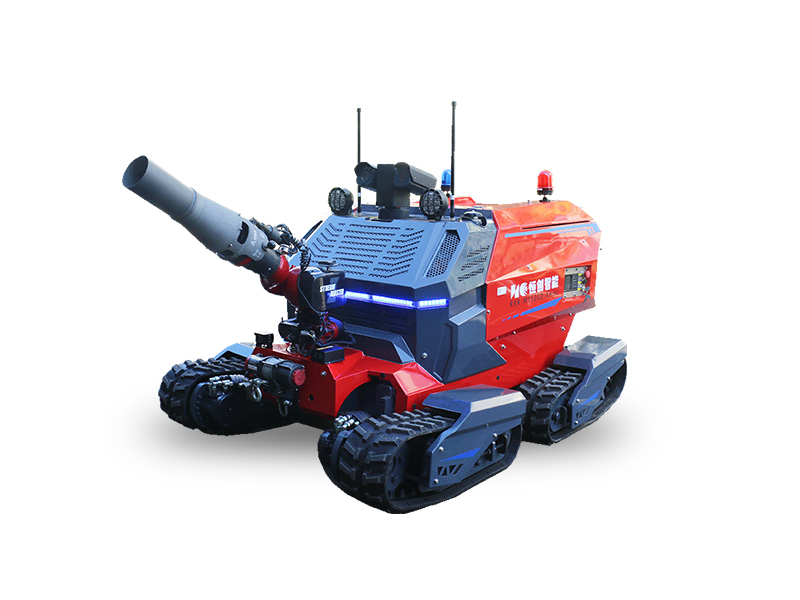
Tunnel construction is one of the most demanding environments in heavy industry. Crews often work in confined spaces, under unstable rock conditions, with limited visibility, airborne dust, vibration, noise, and constant equipment movement. In these conditions, a demolition robot is becoming an increasingly valuable tool. Whether used for scaling loose rock, removing damaged concrete, breaking obstructive sections, or preparing tunnel surfaces, a demolition robot for tunnel construction offers a safer and more efficient alternative to close-range manual demolition.
As tunnel projects become more complex and safety standards become stricter, contractors are relying more on tunnel construction equipment that can perform high-risk tasks remotely. A tunnel demolition robot, especially a remote-controlled demolition robot, helps reduce direct worker exposure while improving precision and operational continuity.
Traditional demolition methods in tunnels often depend on workers operating handheld breakers or placing larger machines in tight work zones. That approach creates several limitations. Space is restricted, visibility is poor, and the risk of rockfall or concrete spalling is much higher than in open construction environments. Manual work also places operators close to unstable faces and overhead hazards.
A demolition robot changes that risk profile. Because the machine is compact and remotely operated, it can enter narrow tunnel sections and perform controlled breaking or scaling without placing personnel directly at the face. This is especially useful in road tunnels, railway tunnels, subway tunnels, and utility tunnels where space and safety margins are limited.
Compared with larger conventional machines, a tunnel demolition robot is better suited to work where maneuverability matters more than raw size. Compared with handheld demolition, it delivers more stable output, more consistent force, and far better operator protection. That is why many contractors now consider robotic systems a core part of safe tunnel construction equipment.
Tunnel jobs involve a combination of hazards that make traditional demolition methods less suitable.
After excavation or blasting, loose rock and unstable surfaces can remain overhead or along sidewalls. Sending workers close to those areas with manual tools increases the chance of injury. A remote-controlled demolition robot allows scaling and breaking from a safer distance.
Tunnel demolition creates high levels of dust, especially when breaking rock, concrete lining, or shotcrete. Prolonged exposure can affect visibility and respiratory safety. Robotic operation reduces the number of workers who need to stay inside the immediate dust zone.
Tunnel sections often limit machine access, worker movement, ventilation, and escape routes. Compact demolition robot for tunnel construction applications are designed to work efficiently in these narrow environments without requiring large operating envelopes.
Traditional breakers require workers to remain close to vibrating tools, unstable surfaces, and falling debris. A tunnel demolition robot removes the operator from the direct impact area, improving both immediate safety and long-term ergonomic conditions.
Safety is the first reason many contractors adopt robotic systems, but efficiency gains are also significant.
A demolition robot can maintain consistent breaking performance over longer shifts than manual labor. Operator fatigue still matters, but the physical strain is greatly reduced because control is remote rather than tool-mounted. This supports more stable production rates.
Because fewer workers need to be positioned at the tunnel face, site managers can lower congestion in hazardous zones. This helps simplify access control, improves workflow coordination, and reduces delays caused by repeated safety repositioning.
A remote-controlled demolition robot can often move between scaling, selective breaking, surface preparation, and localized removal with less disruption than switching between manual crews and larger machines. That makes it valuable for tunnel construction tasks where space is limited and transitions are frequent.
In tunnel construction, overbreak and unintended damage can create downstream costs. A demolition robot gives operators finer control in narrow or sensitive sections, especially around reinforcement areas, concrete linings, ventilation structures, and utility zones.
| Factor | Traditional Manual Demolition | Demolition Robot |
|---|---|---|
| Worker distance from hazard | Very close | Remote operation from safer distance |
| Suitability for confined spaces | Limited by worker movement and safety exposure | Strong, especially with compact machines |
| Exposure to dust and falling debris | High | Lower direct exposure |
| Output consistency | Dependent on worker fatigue | More stable and repeatable |
| Changeover efficiency | Slower in restricted spaces | Faster for multiple tunnel tasks |
| Precision in selective demolition | Moderate | High |
A demolition robot for tunnel construction is not limited to one project category. It can be used across multiple tunnel types where safety, mobility, and precise breaking are critical.
Road tunnel projects often involve widening, repair, lining removal, scaling, and emergency structural work. A demolition robot improves access and reduces the need for crews to stand under unsupported or damaged sections.
Rail tunnels usually demand controlled work windows, strict safety management, and minimal disruption. Robotic demolition helps complete targeted tasks efficiently while keeping operators away from unstable surfaces and tight clearances.
Subway environments often present dense infrastructure, constrained access, and strict vibration or structural control requirements. A tunnel demolition robot is well suited for selective demolition and refurbishment work in these sensitive conditions.
Utility tunnels carrying cables, pipelines, or service systems require compact, careful equipment. A remote-controlled demolition robot provides the control needed to work safely without excessive disturbance to surrounding installations.
The shift toward robotic equipment is not just about modernization. It is about matching the machine to the environment. Tunnel construction relies on equipment that can reduce worker exposure, fit into narrow work zones, and maintain efficient performance under difficult conditions. That is exactly where efficient tunneling equipment such as a demolition robot delivers value.
For contractors, the benefits are practical: fewer people in the hazard zone, better task continuity, more precise demolition, and improved compliance with modern safety expectations. For project owners, the result can be lower risk, more predictable work progress, and better control in challenging tunnel sections.
The main benefit is improved safety. A demolition robot allows operators to perform breaking, scaling, and removal tasks from a safer distance, reducing exposure to falling rock, dust, and confined-space hazards.
Yes, in many cases it is suitable for road tunnels, railway tunnels, subway tunnels, and utility tunnels. The specific model and attachment selection should match tunnel size, ground conditions, and the type of demolition work required.
A remote-controlled demolition robot offers safer operation, more consistent output, better precision, and lower worker exposure. It is especially effective where manual demolition would place workers too close to unstable surfaces or airborne dust.
Tunnel construction is moving toward safer, smarter, and more controlled methods. If you are evaluating advanced demolition robot solutions for tunnel construction, tunnel construction equipment, or efficient tunneling equipment, visit: https://www.hcrot.com/