Concrete removal has always been one of the most demanding tasks on construction and renovation sites. Traditional methods often rely on handheld breakers, saws, or large excavators, which can create safety risks, uneven results, and unnecessary downtime. That is why more contractors are turning to the demolition robot as a smarter solution for modern job sites.
Today, robotic demolition technology is widely used in structural renovation, bridge repair, tunnel work, industrial plant maintenance, and interior strip-out projects. In particular, robotic concrete demolition offers clear advantages when a project requires controlled breaking, access to confined areas, and reduced risk to workers. A well-designed concrete demolition robot can deliver powerful performance while maintaining the precision needed for selective removal.
Concrete is strong, dense, and often reinforced with steel. Removing it efficiently without damaging surrounding structures is difficult. Traditional demolition methods create several common problems:
Workers operating close to the demolition face are exposed to falling debris, dust, vibration, noise, and unstable surfaces. In elevated, enclosed, or hazardous environments, these risks increase significantly.
Large excavators are effective for bulk removal, but they are not always suitable for selective demolition. When a contractor needs to remove only part of a slab, beam, wall, or column, excessive force can lead to overbreak and costly repairs.
Handheld tools are labor-intensive and slow. Large machines may not fit into basements, narrow corridors, tunnels, or industrial interiors. This creates delays and increases labor costs.
These limitations explain why robotic concrete demolition has become an important part of modern demolition planning.
Safety is one of the biggest reasons to invest in a demolition robot. Unlike manual demolition tools, the machine is controlled remotely, allowing the operator to work from a safer distance.
A remote-controlled machine keeps personnel away from the demolition zone. This reduces direct exposure to collapsing material, dust, flying fragments, and vibration-heavy working conditions.
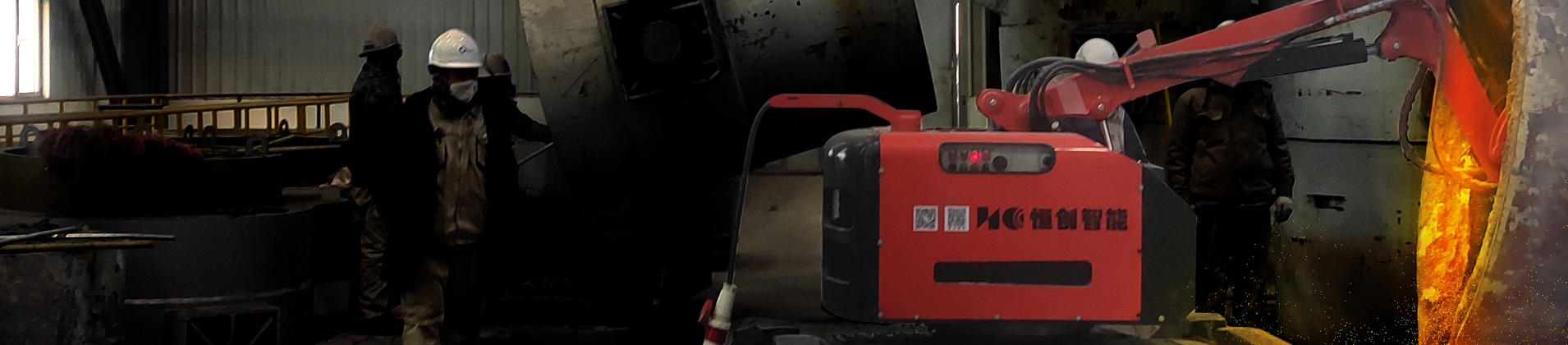
A concrete demolition robot is highly valuable in places where human access is difficult or dangerous, such as tunnels, chemical plants, furnace areas, and structurally weakened buildings.
Manual concrete breaking is exhausting and can lead to fatigue-related accidents. With robotic demolition, the machine does the heavy work while the operator focuses on control and positioning.
In many projects, better safety also means fewer site interruptions, improved compliance, and lower risk-related costs.
Precision is where robotic concrete demolition stands out from conventional demolition equipment.
A demolition robot can target specific sections of concrete without affecting nearby structural elements. This is critical in renovation, bridge rehabilitation, parking structure repair, and industrial retrofits.
Because the machine is compact and precisely controlled, the operator can remove concrete layer by layer. This makes it easier to preserve rebar, avoid damaging adjacent walls, and maintain structural integrity.
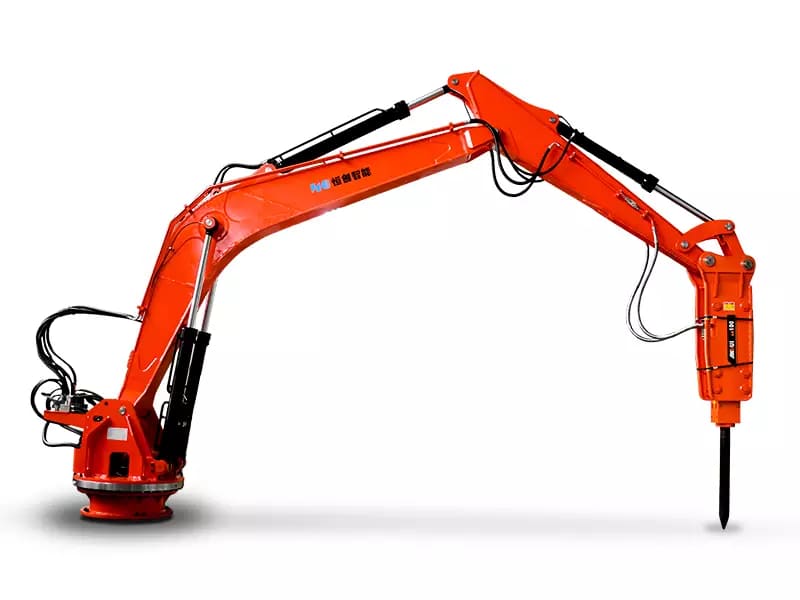
A quality concrete demolition robot combines high hydraulic power with stable boom control. This helps maintain accuracy even when working overhead, on vertical walls, or in restricted areas.
For contractors, this level of control can reduce rework, minimize material waste, and improve the final quality of the job.
Productivity is not just about machine power. It is about how quickly the work can be completed with fewer delays, fewer workers in danger zones, and less repositioning.
A demolition robot can enter areas where larger machines cannot operate efficiently. This is especially useful in basements, stairwells, narrow passages, and interior renovation zones.
Many robotic systems support multiple attachments, such as hydraulic breakers, crushers, buckets, steel shears, and drilling tools. This means one machine can perform several tasks during the same project.
Because the machine is compact and flexible, setup time is often shorter than with larger demolition equipment. Operators can reposition faster and continue working with less disruption.
Instead of assigning several workers to heavy manual demolition, contractors can use a smaller team with a concrete demolition robot to complete the job more efficiently.
Over time, these gains translate into lower labor costs, shorter project timelines, and improved site performance.
A demolition robot is especially effective in the following applications:
Ideal for removing concrete walls, floors, beams, and stairs inside buildings where access is limited.
Useful for selective removal of damaged concrete while protecting surrounding structural components.
Excellent for confined-space robotic concrete demolition, scaling, and controlled breaking in low-clearance environments.
Suitable for concrete removal in cement plants, steel mills, power stations, and processing facilities where safety and control are essential.
When a project involves unstable surfaces, dust-heavy zones, or restricted access, a concrete demolition robot offers a safer and more manageable approach.
Not every machine is the same. Before choosing a robotic demolition solution, buyers should review several factors:
A strong machine should deliver high breaking performance without being too heavy for transport or indoor access.
Check whether the robot can pass through access points and still provide enough reach for the work area.
A versatile demolition robot should support different tools for breaking, crushing, and material handling.
Concrete demolition creates strong reactive forces, so machine stability is essential for both safety and precision.
Reliable after-sales support and parts availability are critical for maintaining uptime.
The advantages of robotic concrete demolition are clear. A modern demolition robot improves worker safety by enabling remote operation, increases precision through controlled concrete removal, and boosts productivity by working efficiently in confined and demanding environments. For contractors handling renovation, infrastructure repair, industrial maintenance, or complex structural demolition, a high-performance concrete demolition robot is no longer just an option—it is a competitive advantage.
If you are looking for reliable robotic demolition solutions for concrete removal and structural demolition projects, visit: https://www.hcrot.com/