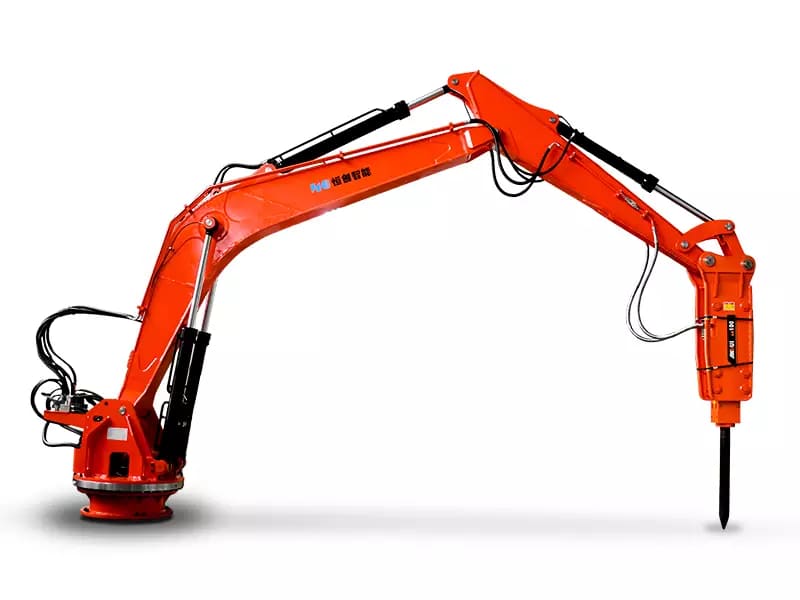
A Rockbreaker Boom System is purpose-built mechanical handling equipment designed to position a hydraulic hammer (often called a rockbreaker tool) precisely at a crusher inlet, grizzly, ore pass, or transfer point to break oversize rock and clear blockages. In practical operations, it replaces manual breaking and reduces stoppages by keeping material flow consistent, especially where a Rock Breaker Machine (hammer) must be applied quickly and safely.
Within the Rockbreaker Boom System category, the most important decision is whether you need a portable rockbreaker system (mounted to a mobile/portable plant or a relocatable skid) or a fixed installation (a stationary Pedestal Boom System anchored to a foundation). Both can use similar breaker tools, controls, and hydraulic power packs; the differences are primarily about mobility, structural design, integration, and total lifecycle cost.
A portable Rockbreaker Boom System is designed to move with or between work sites. It is commonly:
Integrated onto a portable or mobile crushing plant frame (tracked or wheeled)
Mounted on a skid or modular base that can be repositioned with lifting points
Engineered to minimize installation complexity (less foundation work, faster recommissioning)
This type is frequently used in contract crushing, quarry face moves, recycling yards, and temporary mining setups.
A fixed Rockbreaker Boom System (often branded and purchased as a Pedestal Boom System) is installed in one location, typically beside or over a primary crusher, grizzly, or ore pass. It is characterized by:
Structural anchoring to a concrete foundation and pedestal
Higher mass and stiffness to handle heavier breakers and continuous duty
Long-term integration with plant safety and controls
Manufacturers emphasize integration into stationary plants and grizzly/ore-pass sites as a core use case.
A portable Rockbreaker Boom System is selected when the crushing spread relocates often. The system’s value is in redeployment speed:
Less civil work
Fewer anchor bolt patterns to rework
Faster alignment and recommissioning
A fixed Pedestal Boom System is the opposite: it assumes the site is stable for years, and it invests in engineered foundations and permanent guarding. That permanence drives reliability and consistent geometry for the operator.
The boom’s job is to resist dynamic loads from hammering while maintaining positional control. Fixed installations generally win on:
Stiffness (less vibration, better accuracy at full extension)
Durability under high-impact, continuous operations
Higher breaker compatibility (heavier breakers, harder rock, longer duty cycles)
Industry guidance specifically calls out that stationary boom foundation design and positioning are central considerations (because the boom is not “just an excavator arm”).
Portable systems, by contrast, must respect frame limits of the mobile plant and transport constraints. That typically means:
Shorter reach options
Lower allowable breaker mass
More careful attention to weight distribution and transport envelope
Reach varies widely by model, but published specifications illustrate a consistent pattern:
Mobile/portable crusher integration examples show smaller breaker capacity and compact reach, such as handling hammers up to 300 kg with a horizontal reach around 3.17 m (mobile-crusher integration example).
Compact “on-plant” rockbreaker systems for portable setups are commonly marketed with reach ranges in the 12–16 ft (about 3.7–4.9 m) class for small crushing plants.
Fixed Pedestal Boom System offerings often publish longer horizontal reach, such as 6.1 m and beyond depending on model class.
These numbers do not mean every portable system is short or every pedestal system is long; they do show how design priorities tend to differ.
Both portable and fixed Rockbreaker Boom System installations can use joystick control, power units, and plant integration packages.
However, fixed Pedestal Boom System deployments typically have an advantage in:
Permanent guarding, interlocks, and safer operator positioning
Control-room integration and standardized operating procedures
More consistent visibility lines (cameras, lighting, fixed reference points)
Portable systems can achieve similar safety levels, but it often requires more discipline in setup, repeated commissioning checks, and transport-related inspections.
The table below reflects common ranges observed in manufacturer specs and typical installation practices; exact values depend on crusher geometry, rock type, breaker selection, and site constraints. (Where possible, reach/capacity examples are tied to published specs.)
| Dimension | Portable Rockbreaker Boom System (typical) | Fixed Rockbreaker Boom System / Pedestal Boom System (typical) | Operational implication |
|---|---|---|---|
| Primary purpose | Move with portable plants; multi-site use | Long-term station at crusher/grizzly/ore pass | Match to how often you relocate |
| Installation works | Minimal civils; frame/skid mounting | Civil foundation + pedestal anchoring; engineered base | Fixed favors engineered permanence |
| Redeployment time | Hours to a few days (site-dependent) | Days to weeks if relocation ever happens | Portable reduces downtime between projects |
| Breaker capacity (examples) | Up to ~300 kg hammer class in mobile integration examples | Wider range, often higher; model-dependent | Fixed better for heavy, frequent blockages |
| Reach (examples) | ~3–5 m class common for compact/on-plant systems | ~4–7 m+ horizontal reach in many pedestal model lines | Fixed improves access deep into crusher mouth |
| Duty cycle | Intermittent to moderate, depends on project | Moderate to continuous, designed for primary stations | Fixed tolerates sustained impact loads |
| Structural stiffness | Constrained by mobile frame and transport | Optimized with pedestal + foundation | Fixed improves precision and reduces vibration effects |
| Plant integration | Possible, but re-verified each move | Typically deeper, standardized integration | Fixed can be easier to “operate as part of the plant” |
| Total cost profile | Lower civils; higher per-move labor/commissioning | Higher upfront civils; lower variability over time | Decide based on relocation frequency |
The Rock Breaker Machine (hydraulic hammer) is not chosen in isolation. It must fit the boom’s load chart and the target material’s hardness and size distribution.
Portable Rockbreaker Boom System hammer selection tends to prioritize:
Lower weight class for transport and frame compatibility
Efficiency on typical oversize encountered in portable crushing
Simpler service logistics (quick hose swaps, standardized spares)
Fixed Pedestal Boom System hammer selection tends to prioritize:
Higher impact energy and sustained duty
Handling worst-case blockages at a primary crusher mouth
Reduced downtime through redundancy options (greasing packages, robust power unit sizing)
If your plant experiences frequent “bridging” or severe oversize at the grizzly, a fixed Pedestal Boom System often pays back faster because the cost of crusher downtime is usually higher than incremental capex.
You relocate the plant frequently (contract crushing, phased quarrying, temporary sites).
Your blockage frequency is moderate and predictable.
You need a compact boom that integrates onto a mobile frame without major civils.
Your operations value “speed to start” more than maximum duty cycle.
The crusher station is permanent and downtime is costly.
You process hard rock with frequent oversize or bridging.
You want maximum reach into the crusher mouth and stable geometry.
You need high safety integration and consistent operating conditions over years.
Manufacturers commonly position rock breaker systems for stationary grizzlies, ore passes, and primary/secondary crushing stations as long-term productivity assets.
FAQ 1: Can a portable Rockbreaker Boom System be as powerful as a fixed Pedestal Boom System?
In some configurations, portable systems can be very capable, but they are typically constrained by transport limits, plant-frame stiffness, and allowable breaker mass; fixed pedestal installations more often support heavier-duty, continuous rockbreaking at primary stations.
FAQ 2: What reach should I specify for a Rockbreaker Boom System?
Specify reach based on your crusher mouth geometry and the worst-case blockage location; published examples show compact on-plant systems in the ~3–5 m class and pedestal lines extending beyond ~6 m depending on model, but you should design to your exact station layout.
FAQ 3: Is a Pedestal Boom System only for mining?
No—while common in mining (grizzlies, ore passes, primary gyratories), a fixed Pedestal Boom System is also widely used in quarries, aggregates, and recycling facilities wherever permanent high-uptime crushing is required.