In modern mining, quarrying, and aggregate processing operations, efficiency and safety are inseparable from automation and heavy-duty mechanical systems. One such critical piece of equipment is the Rockbreaker Boom System. Designed to handle oversized rocks and material blockages, these systems play a vital role in maintaining productivity at crushing stations, underground mines, and processing plants.
This article explores how hydraulically operated rockbreaker systems work, with a special focus on the Rockbreaker Boom System. We will also cover related concepts such as the stationary rock breaker, rockbreaker, and Pedestal Boom System, explaining their structure, working principles, and practical applications. By the end, you’ll have a comprehensive, technical yet readable understanding of why these systems are indispensable in heavy industries.
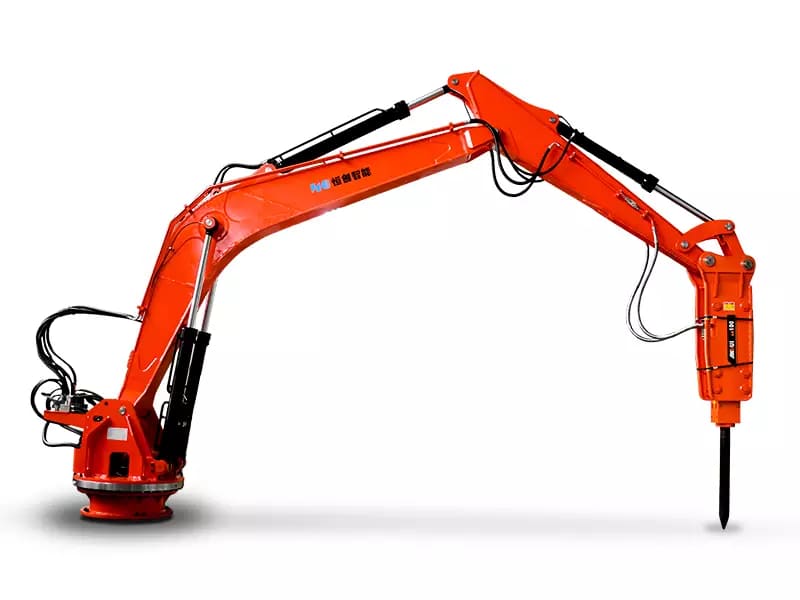
A Rockbreaker Boom System is a hydraulically powered mechanical arm fitted with a breaking tool, typically a hydraulic hammer. Its primary purpose is to break oversized rocks, clear blockages, and manage material flow at crushing or transfer points.
Unlike mobile excavator-mounted breakers, a Rockbreaker Boom System is usually installed as a stationary rock breaker, fixed to a concrete pedestal or steel base. This configuration allows for precise control, higher stability, and safer operation in confined or hazardous environments.
You may also encounter the term Pedestal Boom System, which refers to the same concept: a rockbreaker mounted on a pedestal foundation to provide optimal reach, strength, and durability.
Hydraulic power is the backbone of any Rockbreaker Boom System. Hydraulics provide:
High force output in compact components
Smooth and precise motion control
Excellent reliability in harsh environments
Ability to absorb shock and vibration
In a rockbreaker, these advantages are critical. Breaking rocks requires immense energy, and hydraulically driven systems deliver that energy efficiently while protecting the machine and operator.
To understand how a Rockbreaker Boom System works, it’s important to break it down into its core components.
The boom is the articulated arm that positions the breaker tool. A typical Rockbreaker Boom System consists of:
Primary boom – provides overall reach and height
Secondary boom – allows fine positioning and flexibility
Slew mechanism – enables left-right rotation
These joints are powered by hydraulic cylinders that convert fluid pressure into controlled mechanical movement.
The rockbreaker itself is the tool that applies impact force to the rock. Inside the hydraulic breaker:
Pressurized oil drives a piston
The piston strikes a tool bit (chisel or moil point)
Repeated impacts fracture the rock
This process happens dozens or even hundreds of times per minute, depending on system design.
The Hydraulic Power Unit supplies pressurized oil to the Rockbreaker Boom System. It includes:
Hydraulic pumps
Oil reservoir
Filters and cooling system
Control valves
The HPU ensures stable pressure and flow, which directly affects breaker performance and system lifespan.
Modern stationary rock breaker systems often use:
Manual joystick controls
Remote control panels
Electro-hydraulic automation
Advanced Pedestal Boom System installations may integrate cameras, sensors, and programmable logic controllers (PLCs) to allow semi-automatic or fully remote operation.
Let’s walk through the working principle of a Rockbreaker Boom System in a real operational scenario.
In crushing stations, oversized rocks can block crushers, grizzlies, or chutes. Operators visually detect or are alerted by sensors that material flow is interrupted.
Using hydraulic controls, the operator moves the Rockbreaker Boom System into position. Hydraulic cylinders extend or retract, enabling precise movement in vertical, horizontal, and rotational directions.
Thanks to the pedestal-mounted design, the stationary rock breaker remains stable even when exerting high breaking forces.
Once positioned, hydraulic oil is directed to the breaker. Inside the rockbreaker:
Oil pressure accelerates the piston
The piston strikes the tool bit
Impact energy transfers to the rock
Repeated impacts cause cracks, fragmentation, and eventual breakage of the oversized material.
After the rock is broken into manageable sizes, gravity or conveyors resume material flow. The Rockbreaker Boom System retracts to a standby position, ready for the next intervention.
While both perform similar tasks, their working principles and use cases differ.
Fixed installation
Designed for continuous, high-volume operations
Higher precision and safety
Ideal for crushers, hoppers, and underground drawpoints
A Rockbreaker Boom System installed as a stationary rock breaker is common in mines and large quarries.
Mounted on excavators or tracked carriers
Flexible and relocatable
Lower precision compared to pedestal systems
Best for temporary or dispersed breaking tasks
For permanent installations, the Pedestal Boom System remains the preferred solution.
A well-designed Rockbreaker Boom System offers several operational benefits:
Manual breaking using explosives or handheld tools is dangerous. A stationary rock breaker allows operators to work from a protected cabin or control room, reducing exposure to falling rocks and dust.
By quickly clearing blockages, rockbreaker systems minimize downtime. Crushers operate closer to their design capacity, improving overall throughput.
Blockages can damage crushers and conveyors. A rockbreaker removes oversized material before it causes mechanical stress, extending equipment life.
Hydraulic actuation provides smooth, accurate movements. This precision is critical in confined spaces such as underground mines.
Rockbreaker Boom Systems are used across a wide range of industries:
Mining (underground and open-pit)
Aggregate and quarry operations
Cement plants
Metallurgical processing
Recycling and demolition
In all these applications, the stationary rock breaker ensures uninterrupted material handling.
Hydraulically operated rockbreaker systems are robust, but proper maintenance is essential.
Key maintenance practices include:
Regular inspection of hydraulic hoses and seals
Monitoring oil cleanliness and temperature
Lubrication of boom joints
Periodic replacement of breaker tool bits
A well-maintained Rockbreaker Boom System can operate reliably for many years, even in extreme conditions.
With advances in automation and digital monitoring, modern rockbreaker solutions are evolving rapidly. New systems integrate:
Remote and autonomous operation
Real-time hydraulic pressure monitoring
Predictive maintenance analytics
These innovations make the Rockbreaker Boom System smarter, safer, and more efficient than ever before.
1. What is the main purpose of a Rockbreaker Boom System?
The main purpose of a Rockbreaker Boom System is to break oversized rocks and clear blockages in crushers, hoppers, and material handling systems, ensuring continuous and safe operation.
2. How is a stationary rock breaker different from a mobile rockbreaker?
A stationary rock breaker is permanently installed, often as a Pedestal Boom System, providing higher stability, precision, and safety. A mobile rockbreaker is mounted on movable equipment and is better suited for temporary or flexible tasks.
3. Why are hydraulics used in Pedestal Boom Systems?
Hydraulics are used because they deliver high force, precise control, shock absorption, and reliability, all of which are essential for effective rockbreaking in demanding industrial environments.
By understanding how hydraulically operated rockbreaker systems work, operators and engineers can better appreciate the engineering behind the Rockbreaker Boom System and make informed decisions when selecting, operating, or maintaining these powerful machines.