other
Case

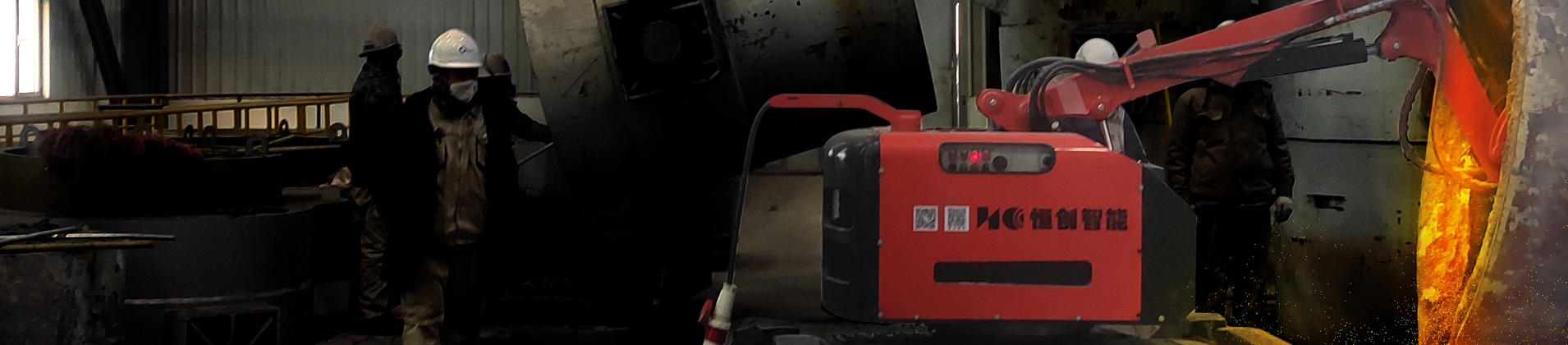
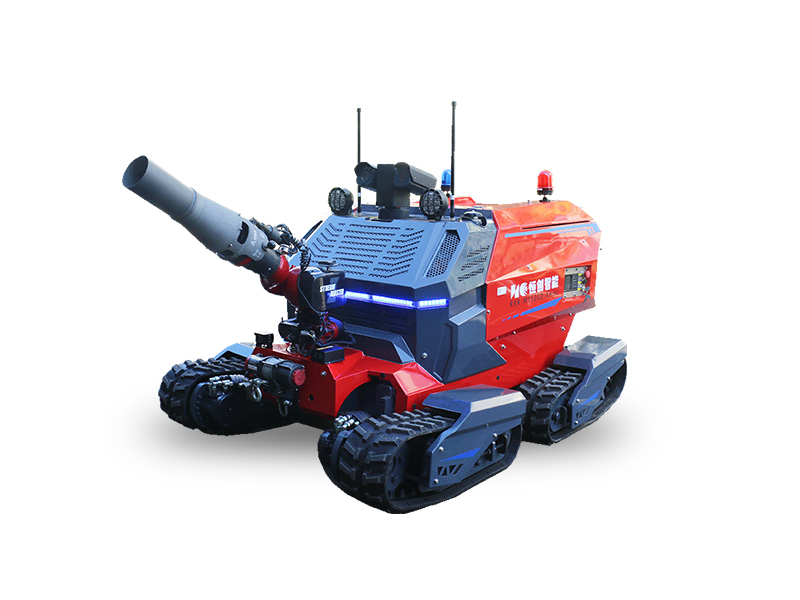
For industries such as steel, metallurgy, mining, cement, nuclear industry, and fire emergency response that require extreme environmental operations, we use robots to replace humans to complete high-risk environmental operations, address the pain points of "being unable to be, being unable to do, being unwilling to do".

  • Demolition Robot | In Cement Industry Ball Mills
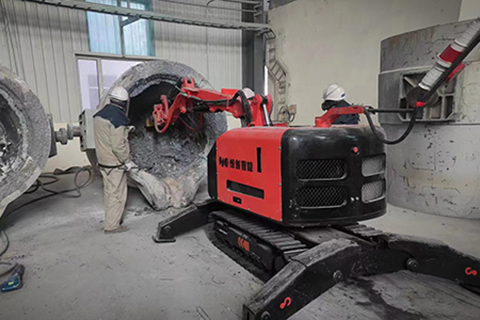
    Demolition Robot Application in Ball Mills of Cement Industry Ball mill is a key equipment for grinding materials in the cement, silicate product, new building material, refractory, fertilizer, black and non-ferrous metal ore beneficiation and glass ceramic production industries. In construction and mining industries, the ball mill consists of main parts: feeding part, discharging part, turning part and driving part. The turning part which is the core part of the ball mill mostly consists of metallic alloy metal liners and lifters with their sizes and shapes designed especially for grinding applications together with plates and bars made of high chromium alloys or manganese series steels as per international specifications. These parts rotate together with the drum body and are responsible for raising the materials and providing good grinding results. The main technical specifications of the ball mill include processing capacity, mill diameter, length and power of the lab ball mill machine. As the first choice of many cement enterprises for the pre-grinding of raw materials and the grinding of clinker, the cement ball mill has many significant differences from other ball mills in terms of structure and performance. The cement ball mill has a small diameter and a large length barrel relative to its diameter. There are various types of balls with different diameters inside the mill. On the inner wall of the barrel, there are lining plates with different shapes. These complex structures help to improve the grinding effect. The operating principle of the ball mill is relatively simple while its performance is very complicated. The factors that influence the operating efficiency mainly include the filling ratio of steel balls, the size of balls, the ratio of large, medium and small balls, the speed of the mill, the viscosity of the material, the temperature of the material, the particle size of the feed, the intensity of the material and so on. The grinding effect of the ball mill depends on the friction and impact of the steel balls or ore particles in the mill, that is, the energy transfer generated when the particles collide with each other. Therefore, the ball mill can not only grind materials well, but also homogenize and blend them. Ball mill is one of the key equipment in cement industry for crushing and milling cement raw materials. The internal lining of ball mill is easily damaged during long-term operation, so demolition and replacement of ball mill internal lining is required regularly. However, the working environment inside the ball mill is harsh, with high temperature, dust and confined space, which brings great difficulties and dangers to the demolition operation. Difficulties in Ball Mill Internal Demolition High temperature: The temperature inside the ball mill can reach up to 200°C during operation, which brings threats to the safety of workers. Dust pollution: A large amount of dust is generated during the crushing and milling process of cement raw materials, and the dust concentration inside the ball mill is very high. Confined space: The inner space of ball mill is narrow, and there are many rotating parts like steel balls, which easily cause physical damages to workers. Space limitation: The interior space of ball mill is small, so it is difficult for workers to take demolition tools into the ball mill. The Solution - Demolition Robot Demolition robot is a perfect solution to solve the problems of ball mill internal demolition thanks to the following advantages: Remote control operation: Operators can control the demolition robot outside the ball mill, which ensures the safety of operators and reduces damages. Hydraulic breaker: The hydraulic breaker equipped on the demolition robot has strong impact force to break hard materials like refractory bricks and concrete in the ball mill. Small size & High flexibility: The compact structure of demolition robot allows it to access to the confined space inside the ball mill. It is flexible to operate in narrow space. Dust-proof design: The electric motors and hydraulic components of demolition robot have dust-proof protection, which enables long working lives in the harsh and dusty environment inside ball mills. Environmental friendly: The demolition robot is powered by 380V electricity with no emissions, so it is energy efficient and eco-friendly. Application of Demolition Robots in Ball Mill Internal Demolition Demolition robots have been extensively applied in ball mill internal demolition in cement industry. The main applications are: Breaking and removal of worn refractory bricks and concretes; Cleaning and removal of accumulated materials; Removal of worn lifters and plates; Drilling holes on the ball mill internal wall; Breaking oversized materials for restarting the ball mill etc. The application of demolition robots greatly improves the efficiency and safety of ball mill internal demolition in cement industry. Demolition robots provide an optimal solution to the problems like high temperature, dust pollution and space limitation inside ball mills with remote operation, hydraulic breaker, compact structure and dust-proof design. HCR170D HCR200D HCR260D HCR300D
  • Rockbreaker Boom | Mine Chutes in Underground Mines
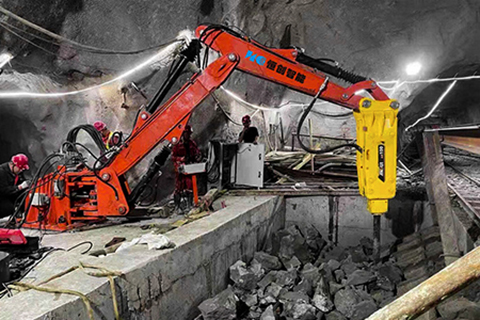
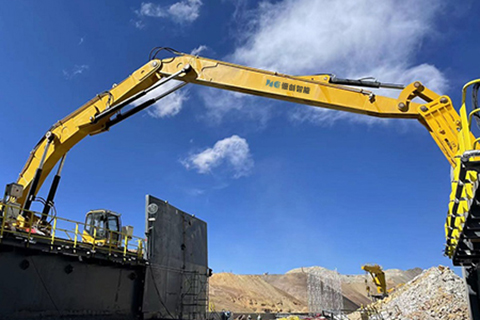
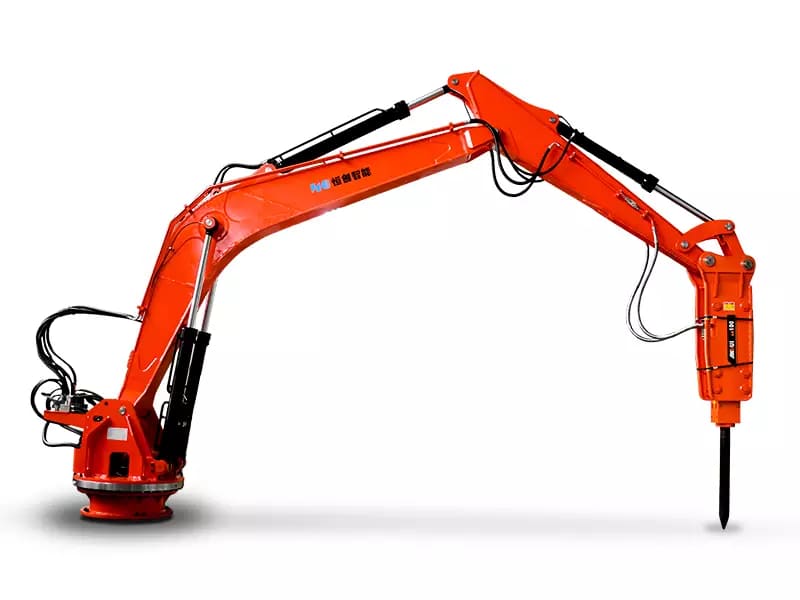
    The Application of Rockbreaker Boom at the Chute Opening of Underground Mines In underground mines, large ore blocks are frequently produced during mining operations and can easily obstruct the chute opening, stopping the flow of ore. Traditionally, small explosives were used to break up these large blocks, but this method is dangerous, costly, and causes major disruptions to operations. A safer and more efficient solution is installing stationary hydraulic mechanical hands at the chute opening. Stationary hydraulic mechanical hands utilize powerful hydraulic hammers to directly crush large ore blocks into small, manageable fragments that can pass through the chute, allowing for continuous ore transportation without needing to halt operations. By breaking down oversized ore immediately, they prevent blockages from forming and eliminating disruptions. Their remote operation allows workers to operate the mechanical hands from a safe distance away in the confined, hazardous space of the chute opening. Compared to using explosives, stationary hydraulic mechanical hands offer significant benefits. They do not require evacuating personnel or stopping the transportation system, allowing ore flow to resume quickly. They also minimize the threat of injury or structural damage from blasting. Hydraulic mechanical hands also provide a continuous solution for managing oversized ore and preventing future blockages, improving productivity. Key Functions Crushing large ore blocks into small fragments to clear existing blockages and restore ore flow promptly without halting the transportation system. By eliminating buildups of oversized ore, they prevent future blockages from forming. Continuously monitoring the ore stream and crushing any oversized blocks to ensure the uninterrupted flow of appropriately-sized ore through the chute. By immediately breaking down large blocks before they accumulate, they enable non-stop ore transportation. Being remotely controlled to operate in hazardous, confined spaces while the operator remains at a safe distance. Workers are shielded from the dangers of operating heavy equipment in restrictive areas with poor visibility. Stationary hydraulic mechanical hands provide underground mines with an efficient, safe solution for managing large ore blocks at the chute opening. Their powerful hydraulic hammers can directly crush oversized ore into suitable fragments for the chute, removing the need for disruptive explosives. They significantly improve productivity by enabling continuous ore flow and preventing delays in operations. Stationary hydraulic mechanical hands are essential for safe, efficient mining. Overall, stationary hydraulic mechanical hands are ideal for solving blockage issues at the chute opening of underground mines. Their capability to remotely crush large ore into small particles enables safer, higher-volume operations. By eliminating the use of explosives, they remove major interruptions to ore transportation. Stationary hydraulic mechanical hands are critical tools for productive mining. HCBS-2520-D HCBM-2520-D HCBSR-3525-D HCBSR-4625-D
  • Demolition Robot | Kiln Maintenance in Cement Industry
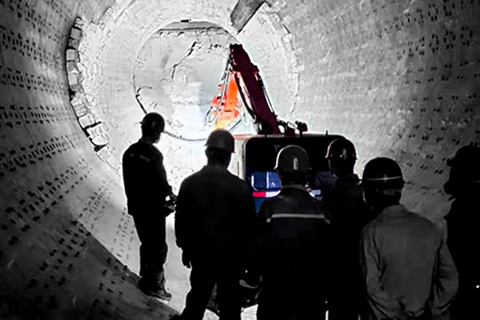
    Demolition In Cement: Revolutionizing Kiln Relining Kiln brick demolition, also known as kiln relining, involves the removal and replacement of damaged refractory bricks lining the inside of cement rotary kilns. Kilns operate continuously at up to 3000°C, and over time the constant high heat causes the refractory bricks and kiln lining to deteriorate, requiring replacement to prevent damage to the kiln shell and ensure efficient heating. The kiln brick demolition process traditionally requires cooling the kiln for 12-16 hours to allow worker access. Hydraulic breakers, jackhammers, and wall saws are then used to systematically fracture and cut out the existing brick lining, a difficult task given the confined space, risk of collapse, and silica dust exposure. Broken brick pieces are removed using buckets, grapples, and hoists. With the old lining removed, workers immediately begin installing replacement refractory bricks. Each brick must be precisely cut and fit to match the contours of the kiln shell. New mortar or adhesive is applied with each layer of bricks, and wall ties are installed to secure the lining. The re-bricking process can take 24-36 hours or more of continuous work before the kiln is ready to be heated up again. Proper kiln relining is essential to avoiding unscheduled kiln downtime, ensuring high product quality, and maximizing refractory lifespan. However, the arduous nature of the work and safety risks involved make kiln brick demolition an area targeted for improvement at most cement plants. New techniques aim to minimize time in the kiln, reduce dust and fume exposure, and prevent worker accidents during relining. Overall, kiln brick demolition represents one of the most difficult and impactful maintenance procedures for cement rotary kilns. When done efficiently, it allows for shorter turnarounds and less downtime between relines, resulting in increased equipment availability, reduced costs, and higher throughput for the plant. Continuous advancement of tools, methods, and best practices for relining helps cement producers optimize this critical process. The Challenges of Conventional Kiln Demolition Kiln demolition, including kiln brick removal and kiln skinning, is critical for maintaining rotary kilns in cement plants. However, the work is done in harsh, confined environments with extreme heat and dust, putting workers at risk of severe injuries. Conventional methods are also very time-consuming, requiring up to 12 hours of cooling before workers can enter the kiln, resulting in long downtimes that reduce productivity. The Solution: Demolition Robots Demolition robots are purpose-built for kiln demolition. They are operated remotely, allowing workers to remain at a safe distance from hazardous areas. Robust hydraulic attachments like breakers are used to systematically demolish kiln bricks, kiln skins, and other buildups inside the kiln. The robots can withstand the high temperatures immediately after kiln operation, eliminating long waiting times for cooling and entry. Optimizing Safety and Productivity By performing the most dangerous tasks, demolition robots prevent workers from exposure to extreme heat, dust, and heavy equipment. They minimize the risks of accidents like falls, burns, and crush injuries that are common during conventional kiln demolition. With far faster cycle times, the robots also reduce downtime from 12 hours to just 3-4 hours per kiln. Their enhanced safety and productivity result in significant cost savings for cement plants. Demolition robots are tailored to the specific needs and parameters of each cement kiln. Remote operation systems provide the flexibility to navigate obstacles and manipulate within the close confines of the kiln interior. Hydraulic breakers and other attachments are selected based on the properties of buildup materials to optimize removal. The robots can be designed to pass through narrow kiln hoods and work in kilns of varying diameters. Demolition robots meet the demanding requirements of continuous cement production. They maximize productivity through high power, fast work cycles, and reliability in extreme operating conditions. By streamlining the kiln demolition process, the robots minimize downtime to help cement plants increase output and revenue. Their competitive advantages in safety, efficiency and cost reduction make demolition robots a key tool for cement manufacturers aiming to optimize kiln maintenance. Overall, they represent a transformative technology that is shaping the future of cement production. They eliminate safety hazards, reduce downtime, and cut costs, allowing cement plants to improve productivity and profitability. The customized and purpose-built nature of demolition robots makes them an ideal solution for the harsh and confined environments inside cement kilns. By tackling one of the most difficult and dangerous kiln maintenance tasks, they provide a competitive edge that makes them indispensable to the cement industry. HCR170D HCR200D HCR260D HCR300D HCR500D

  • Demolition Robot | Cleaning Steel Ladles in Metallurgy
    Transforming Steelmaking Through Ladle Cleaning Steelmaking requires transporting and processing large volumes of molten slag in massive ladles. As the slag goes through repeated heating, cooling, and solidification cycles, it hardens into a dense mass inside the ladles. The Challenges of Traditional Ladle Cleaning The buildup of hardened slag not only reduces the available volume for new molten slag but also impedes material handling, requiring regular cleaning. Manually cleaning slag ladles is an arduous and dangerous task, exposing workers to risks of burns, crush injuries, and silica inhalation. The Solution: Demolition Robots Demolition robots provide a safe and efficient solution for breaking up and removing hardened slag from slag ladles. Through remote operation, the robots can enter the harsh interior environments of the ladles, which remain too hot or confined for human access. Powerful hydraulic attachments like breakers are used to fracture the slag into chunks for removal by buckets or grapples. Some robots feature integrated dust and fume extraction systems to control air pollution during cleaning. Applications in Steel Mills Before each new steelmaking cycle, the slag ladles are positioned under an overhead crane for the demolition robot systems to systematically fracture and remove the compacted slag layers. Emptying and cleaning a large slag ladle can take workers up to 8 hours; demolition robots can complete the work in 3 hours with minimal risks. Their higher productivity minimizes downtime for steelmaking operations. Application and Benefits in Metallurgical Cleaning of Ladles With customized attachments, demolition robots can handle most accumulation trends inside slag ladles, from solidified steel and slag to steel skulls, alloy blocks, and piles. They eliminate the safety risks of difficult physical labor in extreme temperatures while proportionally reducing the time, cost, and energy of cleaning cycles. In an industry critical for continuous steel production, these benefits ensure slag ladles remain passable, available, and ready to receive each batch of molten metal. By tackling one of the most dangerous and time-consuming tasks in steel mills – cleaning slag ladles – demolition robots provide a competitive advantage. Their implementation helps steelmakers improve safety, increase output, and optimize costs in the unrelenting cycle of melting, shaping, and reprocessing one of the world’s most essential materials. Hardened slag is no match for these futuristic helpers, which embody power, efficiency, and around-the-clock reliability. Demolition robots keep steel slag ladles clean so steelmaking operations can proceed at full speed. In summary, the major benefits of using demolition robots to clean steel slag ladles, including improved safety, productivity, and cost-efficiency. They are able to withstand harsh, confined environments and work within them, making them ideally suited to addressing slag ladle buildup removal and fragmentation issues. The time and energy they save help maximize the uptime and performance of steelmaking facilities. Overall, demolition robots are portrayed as a transformative technology for accomplishing such a critical yet perilous industrial task. HCR500D HCR300D HCR260D HCR200D HCR170D
  • Rockbreaker Boom | Assisting Gyratory Crushers in Metal Mines
    The Application of Rockbreaker Boom in Metal Mines Metal ore mining plays an important role in the mining industry. Metal ores contain ferrous metals such as iron, manganese and chromium, as well as non-ferrous metals such as copper, tin, zinc and nickel. In order to extract metals from ores, crushing equipment like gyratory crushers are widely used in metal mines to crush the ores into small particles for further processing. Challenges in Metal Ore Crushing However, the crushing process often encounters problems like ore inlet jamming and blockages. The large ore materials can easily get stuck in the ore inlet and screen outlet of the crushers, disrupting the crushing operations. To clear these blockages and ensure smooth crushing, mines have to stop the equipment frequently for cleaning, which reduces the productivity and efficiency of the mines. The Solution from Rockbreaker Boom Fixed hydraulic mechanical hands provide an effective solution to this problem. They are installed next to gyratory crushers and can handle the oversized crushing and clearing of blockages at the ore inlet. With a high-performance shock absorption system, the fixed hydraulic mechanical hands are safe and reliable to work in the harsh conditions of mines for a long time. They help crush large ore materials that get stuck in the crushers and clear the blockages efficiently without stopping the crushing equipment. Applications and Benefits in Metal Mines The fixed hydraulic mechanical hands are widely used in metal mines to assist gyratory crushers. In open-pit metal mines and underground metal mines alike, they prevent the halt of crushing operations due to blockages at the ore inlet or screen outlet. They improve the productivity and efficiency of mines by allowing continuous crushing. Their application in metal mines demonstrates the significant role that fixed hydraulic mechanical hands play in optimizing the mining process. In summary, fixed hydraulic mechanical hands provide a solution to crushing problems like ore inlet jamming and blockages in metal mines. By clearing blockages and oversized materials efficiently, they improve the productivity and efficiency of mines. Their wide application in assisting gyratory crushers during metal ore crushing highlights their importance in mining. With more mines realizing their benefits, fixed hydraulic mechanical hands are becoming essential auxiliary equipment for metal ore crushing. HCBS-2520-D HCBM-2520-D HCBSR-3525-D HCBSR-4625-D
  • Demolition Robot | Revolutionizing Underground Mining Operations
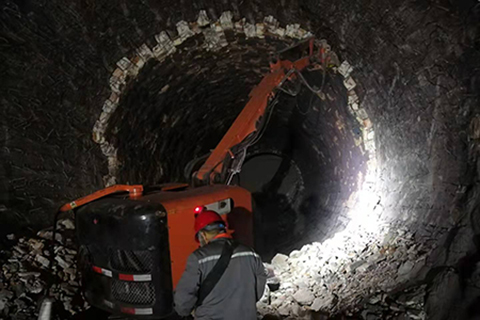
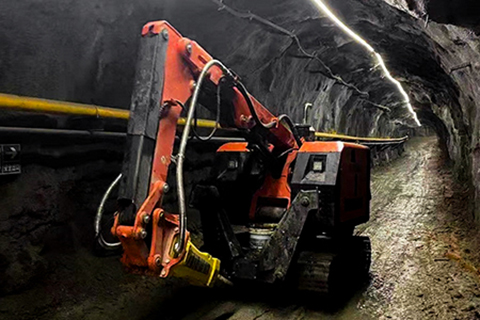
    Demolition Robot for Underground Multi-Purpose Mining Applications Demolition Robot for Underground Multi-Purpose Mining Applications In thin vein mining, compact and remotely controlled demolition robots have huge application potential. 80% of casualties in underground mines occur at the working face. Therefore, allowing workers to remotely control rock drilling, blasting, anchor rod installation and large block crushing can ensure the safety of these workers' lives. The demolition robot provides effective solutions for various underground mining applications with its compact structure, bionic three-section arm structure, non-blind spot operation, remote control operation and other excellent multi-functional designs. The demolition robot equipment uses heavy tracks and legs, which can work on the most uneven terrain. The working arm consists of three parts, providing an unprecedented range of motion, allowing rock drilling, prying, rock crushing and installation of anchor rods in any direction. In addition, the equipment uses a hydraulic system and does not require compressed air, which can maximize the reduction of facilities required at the working face. Electric drive ensures zero carbon emissions from these robots during operation. The same demolition robot can perform multiple tasks such as stripping, rock drilling, prying, mine tunnel maintenance, drilling, etc. It can not only improve the production efficiency of mines, but also improve the safety and sustainability of mining operations. Application 1: Crushing Large Blocks One demolition robot can be placed on a fixed grid or in a blast chamber to crush large blocks without the use of explosives or any unnecessary material handling. We now provide specifications ranging from 0.7 tons to 12 tons. The power-to-weight ratio of each specification is 2 to 3 times that of conventional excavators. Application 2: Ultra-deep Thin Vein Mining Deep vein mining requires equipment with high maneuverability and durability. Although robots can now be selected for large-scale mixed mining, these equipment are not suitable for ultra-deep thin veins. The demolition robot has other advantages such as high safety and high productivity of remote operation, high flexibility, high precision, etc. Some gold mines have achieved the above purpose by increasing the demolition robot in their deep vein mining. The demolition robot stitches its excellent power-to-weight ratio, which is usually equivalent to machines twice as large as existing equipment, and its efficiency is far greater than the most advanced pneumatic leg drill. It can withstand the high temperature and high pressure conditions of ultra-deep mining. According to statistics from a mine using demolition robots in deep mining, compared with traditional manual methods, using demolition robots can reduce labor costs by 60% for mines to advance one meter deep. Application 3: Mine Tunnel Maintenance Remotely controlled demolition robots can more efficiently perform two other tasks: repair and maintenance of mine tunnels. In recent years, mining methods have changed. Many mines are re-mining old veins with more advanced equipment to supplement ore production. However, abandoned mines are in a state of disrepair. There are large rocks, collapsed support systems and falling pipelines in the mines, making the mine clearing process slow and dangerous. In addition, as mining technology advances, mines require stricter safety standards. Therefore, a lot of work may be required to meet modern regulatory requirements when repairing old mines. In these cases, the versatile demolition robot can minimize equipment and personnel requirements and very efficiently complete mine repairs. For example, during initial repairs or refurbishments, the robot can use a rock breaker to remove loose rocks. During mine clearing, the robot breaks large blocks in a non-explosive manner to improve efficiency. Therefore, the mine does not need to stop operations and evacuate personnel for large block blasting. Then, the operator can switch the robot's tools to remove support components and pipelines using shearing tools or multi-blade attachments, and drag away pipelines or discarded support beams. After installing a grab bucket on the robot, it can transport materials and carry out mucking. Drilling components can be used for large block blasting as well as installing support systems and suspension devices. The grab bucket can be used to install support rebars, safety nets or wire nets, as well as install new auxiliary facilities such as tracks, pipes or cables. Finally, the robot can also use shotcrete attachments purchased from leading manufacturers. Mines using demolition robots to repair abandoned mines can double the monthly depth increase and reduce labor requirements by 44%. The multi-functional design features of the demolition robot provide solutions such as mechanization and safe maintenance for mining. It can not only improve the productivity of mines, but also improve the safety and sustainability of mines. HCR70D HCR120D HCR170D HCR200D HCR500D
1 2 3 4

A total of4pages

Leave a message

Leave a message
Thank you for visiting Hitech. For further information about our products and business, fill out and submit the form, we'll get back to you as soon as possible.
Submit

Home

Products

About

whatsApp